Showing posts with label fantastickal. Show all posts

Monday, June 30, 2014

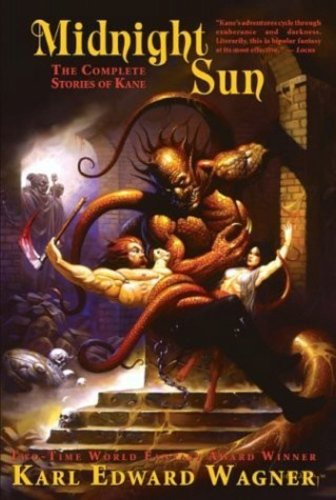
Midnight Sun: The Complete Stories of Kane

by Karl Edward Wagner

Karl Edward Wagner was many things: originally trained as a psychiatrist (a profession he ended up rejecting), a longtime editor of the influential Year's Best Horror and Fantasy series, a poet, a writer of dark horror, an alcoholic (it eventually killed him), and - perhaps most famously - the author of a series of odd stories and novels featuring the immortal Kane. this iconic character is widely considered to be the most successful of all the Conan-esque creations to follow in Conan's footsteps.
715273Wagner writes his Kane stories using a dark but vibrant palette of throbbing colors. his pastiche of the classic Robert Howard style manages to stay true to the form while injecting his own brand of despair, various hallucinatory elements, and a deeply cynical outlook on life. these tales of 'adventure' often read as gripping horror stories (plus swords & sorcery, 'natch) that are informed by a very modern nihilism and a free-floating feeling of ambiguous menace.

Kane himself is none other than that infamous brother-slayer, Cain, cursed to immortality for his crimes by - as Wagner sees fit to describe - "a long dead god." it is interesting to see an author use a biblical character while completely rejecting the religion that created that character. it is even more interesting to see how that immortality plays out, story by story. events and places and people that Kane encounters in one story become historical tales told by people in other stories - no doubt with Kane silently smirking at the mistelling of those stories. ah, immortality. what a cross to bear!
Wagner cheats a little bit in these tales. at different points in his career, Kane is a Machiavellian courtier, a bloodthirsty warlord, a murderous sorcerer... his history is that of an immortal, capital-V Villain, one who causes kingdoms to fall and cities to be sacked and towns to be plundered, happily manipulating events for his own obscure goals, an infernal architect of countless plans that result in the deaths of countless people. he's not tragic or noble - he's a monster. the cheat comes in that we never actually see that particular Kane, those different villainous aspects - at least not in the stories collected in this compendium. instead the reader meets Kane between his notorious misdeeds and misadventures. we don't see the cruelty or the devious machinations; we see those presumably rare moments when Kane is on the run or is revisiting the scenes of his crimes or is just having a little side adventure that actually isn't hurting anyone. we see Kane when he is kind - when he protects the weak and rescues the innocent. an odd but usually very effective strategy. I came away from this book feeling pretty sympathetic to the character.

the first seven stories amazed me! thrilling, often sinister tales that portray a compelling antihero and atmospheres full of sorrow & regret, or hot-blooded but misguided vengeance, or the threat of sexual violence, or intangible dangers, or all of that combined. "Undertow" cleverly uses parallel narratives to illustrate why Kane's girlfriend is someone we all should just avoid pursuing. the bittersweet "Two Setting Suns" details Kane's journey with a giant as his companion attempts to reinvigorate his dying race. "The Dark Muse" is very Clark Ashton Smith with its drug-taking poet and interdimensional threat and scary journey through the ruins of a dead city. the remaining stories of this first seven ("Raven's Eyrie" & "Misericorde" & "Sing a Last Song of Valdese" & "Lynortise Reprise") are all equally compelling.

the stories that follow are less compelling. I don't know what happened here. "Reflections for the Winter of My Soul" (that title!) and "Cold Light" have so much promise and do such an excellent job at creating an intriguing premise full of eerie atmosphere... but they are done in by the terrible anachronisms of the dialogue - it gets genuinely laughable at times - and the extreme overuse of exclamation points!!!!!!!!!!! "Mirage" and "The Other One" are not bad, but are also rather flimsy and unmemorable. the less said the better of the Kane-meets-Elric adventure "The Gothic Touch."

there are three modern day stories of horror featuring Kane in his new guise: a drug-dealing man of extraordinary wealth engaged in a battle against the forces of evil. or just engaged in drug dealing. frankly, these three stories are terrible. the modern elements are eye-rollingly awkward, with the exploitative use of 'alternate sexuality' feeling particularly forced. the protagonists are pathetic and irritating. also... an Elvis dildo, really? ugh. the experience of reading "Lacunae" & "Deep in the Depths of the Acme Warehouse" & "At First Just Ghostly" was repellent, to say the least.

I hate to end my review of such an interesting and idiosyncratic author on a sour note, so I'll repeat myself: those first seven stories were FANTASTIC. so good that they have helped me pretend that those other stories don't even exist. I am really looking forward to reading the three Kane novels, all thankfully set in archaic times.

Monday, March 24, 2014

The Weirwoods

by Thomas Burnett Swann

9361326the name of Thomas Burnett Swann's game is Pastoral Fantasy vs. Slowly Encroaching Civilization. the author wrote a good number of fantasy (and some science fiction) novels that took the old myths and legends as reality and pitted them against the gradual intrusion of industry, the city, the military, modernity in general. one of the delightful things about this author is his ability to make these myths real in their own strange, unreal way. his dryads and water sprites and centaurs and fauns are three-dimensional yet often utterly alien as well. although it is obvious which side Swann is on (and what fantasy author will ever side against fantasy anyway), he also illustrates his early civilizations with the same trappings of fantasy - these aren't the ancient civilizations of the classroom, they are cultures that have been made almost as mythical as the fantasy creatures who share their world. entering one of Swann's novels is entering an adult fairy tale; very little is familiar except for the familiarity we all have with myths & legends & ancient civilizations. these myths & legends have been given a compelling sexuality that is central to their mythology. this is definitely Sexy Fantasy: the sexuality manages at different times to be genuinely sensual and carnal yet also innocent - not dirty and not exploitative, sometimes disturbing and threatening, often deeply homoerotic (and honestly I wish he had been a bit more even-handed with the ladies), and just as often unintentionally silly - and silly in a rather dated, eye-rolling, but still amusing way. anyway, The Weirwoods is about water sprites and Etruscans, a terrible revenge, and how a traveling musician, a naïve city girl, and two deadly but weirdly attractive water sprites all cross paths. his prose is lovely and his story manages to feel languorous despite its brief length. it is a serious book and it is also often a really goofy book (especially in its second half, post-revenge). overall I quite liked it; it took me right into another world and I wanted to stay there longer than I was able. I'm looking forward to reading more by the author and I'm excited to reread the ones I read as a teen. they certainly inspired dozens of my own smutty fantasies. but also a longing for things long past and things that never were.

Monday, March 3, 2014

Tender Morsels

by Margo Lanagan

Snow White and Rose Red live with their mother in a cottage. upon them comes a bear, out of the cold, into their warmth and into their lives. he stays with them a bit; they become a sort of family, until he must go away. the girls meet a strange and irritable dwarf and save him several times. he is not grateful. later, the girls come between the dwarf and the now enraged bear. the unpleasant dwarf begs the bear to eat the girls rather than his little self. can the girls' sweet spirits get them out of this mess - are the girls able to survive? they can, and they will!

 photo tendermorsels_zps63324dce.png

a young girl's mother dies, and she is left with her horrible father in a cottage. she is repeatedly molested and impregnated by her father. it is important that you know this, that this is a part of the book and this is a part of life, for some. a young girl loses her father and is happy for a time. a group of boys come upon her, pull her down from the chimney where she has fled, and proceed to rape her. it is important that you know this, that this is a part of the book too and this is a part of life, for some. can this much-abused girl survive? she can, and she will.

2662169a woman writer named Margo Lanagan decided to write a book about women. she would make the book a portrait of a family of women, a family that grows bigger. she would make the book a portrait of motherhood and sisterhood and daughterhood, the challenges and the wonder and the excitement of becoming, of transforming into such roles. she would make this portrait of women a part of the greater world, so there are many voices heard, even voices of men, sympathetic men and strong, kind ones too. the book does not share the voices of those who are brutal and who destroy with their brutality; they are not worthy of having their voices heard and they are not missed. well, there is a certain voice, a harder voice: the dwarf. but his story is its own kind of tale, not the story of a brutal man but rather the story of a man small in stature and in spirit, an occasionally unkind man but not a brutal one, and one deserving of some sympathy. so this woman writer would take the fable of the sisters Snow White and Rose Red, their cottage and their mother and that dwarf and the bear-who-was-a-prince, as her template. men in the shape of bears and women in the shape of women. she would spin this tale out of prose that is light as gossamer, pliant as cotton, soft as flax, sturdy as wool. prose that sings; prose that whispers. can a woman do all these things in one book, tell all these tales, and still stay true to her goals and still stay true to the myth itself? she can, and she did.

I was once a residential counselor for runaway kids. one girl in particular, I remember her well, she came from a history of sexual abuse, like many others. she fled to the house where I worked. one night she went out wandering and upon her came a group of men. they raped this girl, this girl who had already suffered so much. was she broken though? she was, for a little while. but she came back, she healed, not completely because these kinds of wounds never heal completely, but she did heal. she was young and I know that this was still the beginning of her story. could she survive this beginning, could she survive and even thrive, one day? she could, and she did.

I thought of this girl quite a bit while reading Tender Morsels, her survival. the first 50 pages were exceedingly hard for me to read, for many others to read as well. sometimes these kinds of stories need to start hard. but they don't need to stay that way, only hard, they can expand and move beyond and transform, become something different, something more than atrocity, some bright and warm and ready to embrace those who have been hurt and who long for that bright warmth. can stories that start with such terrible things remain hard - even vengeful - while also growing softer, a soft side and a hard one, side-by-side, life is all sides, can a story juggle such things, even up until its very end? it can, and it did.

Friday, February 14, 2014

The Magician King

by Lev Grossman

The Continuing Adventures of a Smug Magical Asshole, as written by An Asshole. and now featuring The New Adventures of a Completely Self-Absorbed Bitch.

i suppose i understand the acclaim that has been heaped on Grossman. he is playing with tropes as his characters play with magic. he has a puckish sensibility that makes reading his series a tart and spiky experience. his tone is breezily casual and entirely unsentimental. and since Snark is the New Law of the New Millenium, the snark that is delivered in spades throughout his novels probably lets many readers off the hook of reading genre fiction... everything is delivered neatly wrapped up within a knowing, eye-rolling, jaded wrapping paper. this gift can be unwrapped at sophisticated dinner parties and the reader won't have to suffer any kind of embarrassment over reading and talking about "Fantasy".

10819920
but i had to do a lot of eye-rolling of my own. it's not as if The Magician King is just about a shallow little prick who views everything - and i mean Everything - around him with disdain. i probably would have less of an issue with this book if it were simply about an unsympathetic protagonist. but nope, the author himself makes it clear that he is officially on the side of cynical, snarky assholery. it is all in the writing itself, and not just in the voice of our tedious hero. i can start with the ending, where banality has been substituted for actual meaning and resonance. but the problem is endemic to the entire narrative. people and places are described in the same shallow, smirky, insulting manner, as if the book was actually written by our tedious hero. a bit of the jokiness scores; most of it just falls flat, with a thud. like the irritating, oh-so-clever commentary of some overly-intellectual prick at a party, going on and on about how pedestrian tv is, how terrible music is these days, how pop culture is for idiots, how he's been there, done that, and there were so many tourists and it was all so predictable and banal and now he's rolling his eyes and arching his eyebrows and i just want to smack the bullshit right out of him. in short, this novel lacks SINCERITY.

10079321okay, enough of the complaints. there is still a lot to enjoy. first off, new co-protagonist The Completely Self-Absorbed Bitch is actually pretty interesting and her parallel flashback adventures are often enthralling. the way that the parallel narratives of our heroine's past and our hero's present eventually dovetail into one narrative is clever and quite elegantly structured. an island battle is genuinely thrilling. the novel's major set-piece, where a bunch of brilliant but mentally ill magicians conjure up an actual god is pretty awesome - and very upsetting. the story of young Benedict is also quite well-done... there is genuine tragedy and sadness there, in a way that really stands out from the rest of the narrative. and extra points for portraying rape without even the slightest bit of offensive sexiness.

i was happy to see my favorite characters from the prior novel, Penny and that novel's superb villain Martin Chatwin, both return in a couple excellent cameos. and many of the ideas are wonderful - in particular the Neitherlands, dragons, Venice, the return of the old gods, magical halfway houses, a magical ship, magicians who have somehow transitioned into higher beings, the seven golden keys, a sloth, the Customs Agent and especially her daughter... and i'm probably missing a few equally choice nuggets. The Magician King is deeply flawed and its juvenile tone may be instantly dismissable; it is also practically brimming over with a host of smart, fun, and intriguing moments. much like a creative, outsider-type teenager - full of unearned cynicism and irritating snarkiness, but also full of vibrant energy, a host of ideas, and a fresh, sometimes even brilliant way of looking at things.

so, when all is said and done, i'd actually recommend this book as an interesting and often enjoyable experience. but i'd have to give a big disclaimer before recommending it - a disclaimer delivered with a little snark and a lot of eye-rolling.

Tuesday, February 4, 2014

The King of Elfland's Daughter

by Lord Dunsany

14686a tale out of time: an old myth reinvented; a new myth born. a wayward bride, a forlorn husband, their son - a pitiless hunter. a defiant old woman; a melancholy old man. trolls delight in delight; unicorns are for slaughter. question: what is Time in Elfland? answer: a fantasy! twelve men want magic. madmen shall take captive a king. borders shall be crossed and boundaries may be as fleeting as dreams. be wary of what you wish for! love shall conquer all and death shall be no more.

prose like poetry, like music. the novel: a silvery lake stretching to shores unknown. i gazed at this lake by day and its surface shone with sunlight: the world and all its colors flamed bright and fierce. i took a lonely boat ride by night and its surface glistened with moonlight, reflecting the beyond... i stared into those starry depths and saw the infinite: an entrancing sight!

Photobucket

Tuesday, January 28, 2014

Ombria in Shadow

by Patricia A. McKillip

781124this is a beautiful, dreamy fantasy. it is about a fallen city, the mysterious city under that city, two magical beings, a royal bastard, a cast-out mistress, a kind of changeling, a curious scholar, a lonely child prince. it is about ruthless control and equally ruthless revolution against that control. although it does not have faerie, it is a fairy tale, one that is both modern and classic in tone and structure. the writing is splendid; McKillip's words are like gems that she strings together to make a sparkling kind of wonderful. she does not overwrite her story; her prose is lusciously rich, almost edible - but it is also streamlined, stripped-down, full of ambiguity and meaning yet never spelling things out too explicitly, never getting lost in detail. sometimes you have to step back, to appreciate the vivid beauty conveyed on the page, to wonder over the mysteries being so carefully teased out, piece by piece. the setting, the city of Ombria, is a marvel: a sad, gloomy, violent, desperately alive place, one that has fallen far from its glorious history; a sad, gloomy, mysteriously un-alive un-place, a shadow city beneath and between and co-existing with the living spaces of Ombria, an un-living history. Ombria in Shadow is full of magic, tragedy, mystery, and love.

MAGIC: it is front and center. don't expect rules to this magic, although it doesn't feel random. it is simply not spelled out. it is as ambiguous and mythic as the rest of the tale. its two sorceresses - one a fell and fungal villain of the darkest hues and the other an unsettling force of nature, change, and potential catastrophe - are marvelous creations.

TRAGEDY: there are the central tragedies, of course, the greater ones that dominate the narrative. but McKillip does an excellent job in making the tragedy hurt beyond those larger strokes, beyond the death of a king, beyond the attempted murders, beyond the ruination of a city. she makes the tragedy felt in many small ways... casual violence in the night, the distance between father and daughter, lovers parted and lost, the feeling of disempowerment, the loneliness of a little boy.

MYSTERY: answers are almost always tantalizingly out of reach, parsed out little by little, nothing ever simply dumped on the reader. the ending gives you answers, but they are not straightforward, they require contemplation and a willingness to forsake easy answers and easy satisfaction. when they come, the answers were almost as mysterious as the mysteries themselves. that said, when the riddles of the nature of the two sorceresses were finally answered, separately... marvelous to read, perfect.

LOVE: my gosh i was delighted about the Love that is at the heart of this tale. specifically, the love between children and those people in their lives who love them and care for them - be they parents or friends or guardians. of course i have nothing against Romantic Love and its place in any story. but how refreshing to have that focus changed! there are Love Stories in Ombria, naturally. but this book has at its heart Familial Love - with "family" being one that is both born and chosen.
this is the kind of book that you just want to hold close to your heart, be sentimental over, and think about again... but perhaps not talk about, at least not too much. it is a delicate book, like most precious things.

Thursday, October 10, 2013

A House of Pomegranates

by Oscar Wilde

Once upon a time there was a little collection of fairy tales called The House of Pomegranates by Oscar Wilde. I opened this book up and found a whole different book than the one I had expected! Is that a good or a bad thing? Well, I suppose both.

My familiarity with Mr. Wilde is pretty much based on his decadent excoriation of decadence and beauty-for-beauty’s-sake The Picture of Dorian Gray and his brilliant and perfect and of course sublimely witty The Importance of Being Earnest. I figured I would be getting more of the same, or at least a little of one and a lot of the other or some such combination. Nope.

spoilers ahead...

✲

The third story “The Fisherman and His Soul” is fascinating. Starting off as a vaguely familiar tale of a lovelorn young fisherman who gives up his soul to be with the mermaid who has stolen his heart, it quickly moves in stranger directions. There is a witch who falls in love with him, who brings him to a moonlit satanic ritual to meet her diabolical master, who declares her love and then shows him how to cut his soul free. Then we learn about his cast-out soul’s journeys. Such journeys! The soul learns about Knowledge and Wealth and Lust. And, most surprisingly, the soul has terrible powers and with those powers does terrible things. A phrase uttered by the soul as he recounts his acts to the fisherman, “And I did a strange thing, but what I did matters not…”, is repeated three times and it is unnerving, chilling. Why does the soul do the terrible things it does? Apparently because when the fisherman cleaved his soul from his body, his soul got none of his heart. A heartless soul! Strange. His soul is soulless. For some reason I have always identified the soul as equaling the heart, part of a kind of trinity: Body, Mind, Soul (Heart). Wilde does not see it that way. The soul returns to the fisherman repeatedly, telling him of his adventures, always trying to reunite with him in the same body. And finally the soul does tempt the fisherman away from his undersea home, despite the peace and satisfaction that the fisherman has achieved with his mermaid love. The soul leads the fisherman astray; he compels him to do terrible and cruel and inexplicable things. There is an unhappy ending. And then there is a kind of happy ending, poetic and transcendent and, yes, strange.

6329642What does it all mean? Hard to say. Of the four stories, this one reminded me the most of Dorian Gray, in its emphasis on decadence and on the idea of breaking up the psyche into different parts. Elsewhere the spirit or soul is usually seen as a kind of agent of transcendence; yet here it is the fisherman who has achieved true transcendence - without his soul. Perhaps the soul is the form of the fisherman’s unconscious. The fisherman reaches his own transcendence by achieving his strongest desire, by falling in love: a love that is connected to his heart and one that is a palpably <i>physical</i> love. The mermaid is described in language that defines her as a beautiful and very material being: a body of ivory, a tail of silver and pearl, each separate hair a thread of gold. What is Wilde saying? That we can find our own riches in the physicality of love? That we don’t need those terrible adventures that force us to confront the true nature of Knowledge, Wealth, and Lust, that these are all Outside Forces that are in the end truly meaningless? That the fisherman's soul journeys towards a kind of living death and, later, in his attempt to use "good" and "evil" to influence the fisherman - that he is constructing a false binary of good vs. evil, an ultimately meaningless duality? That pure transcendence can be found in the romantic and sexual desires of eros, within the heart that acts as the fulcrum of the, er, "pleasure principle"? Love = the Id, and that's not so bad, not bad at all? Or at least love equals whatever the id was considered to be, prior to Freud? Sorry to bring up Freud, I know he’s unpopular & discredited & all that, but the fisherman's actions do seem to exist as the opposite of Freud's “reality principle” - in his disinterest in deferring gratification of his desires, in his rejection of the circumstantial and material reality that his village priest invokes to stop his quest to lose his own soul. Is the heart the true agent of transcendence, one that is linked to regeneration? The ending points me in that direction... flowers blooming on unconsecrated ground, over the body of the dead fisherman; a narrow-minded priest suddenly finding himself lost in his own passionate moment of transcendence and connection to the beauty around him.

✲

2298136The first and fourth stories, “The Young King” and “The Star-Child” are quite charming in their own way. Certainly the prose is beautiful, jewel-like. One is the story of a young king who learns that to love the beauty of material goods is to support the enslavement and oppression of the people who create those goods; in the end he achieves a glorious and godly transcendence in a church. The other is the story of a child who is beautiful, vain, and cruel; that child is transformed into an ugly creature and is then tormented until he achieves his own glorious and godly transcendence. Charm and jewel-like prose, yes, but I actively disliked both of these stories. I don’t have a problem with religious themes in my fiction; I’m a God-lover myself, so bring it on. But my God! The messages in these two stories were so trite, so mawkish… frankly, I became rather nauseated at the ever-increasing relentlessness and obviousness of Wilde’s goals in telling these tales. All that charm became charmless. Even worse, the themes of these particular tales almost act as a renunciation of some of the ideas present in the far more complex and satisfying story of the fisherman.

✲

11666298The second story “Birthday of the Infanta” is a troubling and very intriguing little tale. Lovely and grim in equal parts. A Spanish princess, a king mourning the death (murder?) of his wife, sinister courtiers who may have sinister designs on the royal child… disturbing things bubbling away under the surface. And then all of that is discarded as we learn the story of a dwarf brought to entertain the princess on her birthday. His purity, his love, his connection to nature are all detailed movingly. As is his lack of understanding in how he is viewed by those around him - as an ugly joke. In the end, after seeing his reflection in a mirrored wall and so learning his true place in the world of man, in the world of the princess… he dies of a broken heart in front of his own image. The meaning of the story seems timeless. Unlike my experience with the two stories above, I was not remotely annoyed - perhaps because the story is so bracing in its clear-eyed sadness at the cruelty of the world.

A striking, resonant, and somewhat heartless ending... after our little princess comes across the body of the good dwarf, she fails to understand that her toy has broken permanently and is annoyed when told that the death was due to a broken heart:
 
And the Infanta frowned, and her dainty rose-leaf lips curled in pretty disdain. “For the future let those who come to play with me have no hearts,” she cried, and she ran out into the garden.

I found a lot of my own vague ideas given concrete form in Heather Marcovitch's excellent essay: 'The Fisherman and His Soul' and the Unconscious

Monday, October 7, 2013

The Hundred Thousand Kingdoms

by N.K. Jemisin

6437061a pleasingly old-fashioned fantasy - and by old-fashioned, i mean the opposite of the dense, complicated, multiple perspective, incredibly epic mega-fantasies that have had the most popularity over the past couple decades. this is something different. the language is straightforward, for the most part, and certainly beautiful at times. although the mystery is a complicated one, and deals with rather large issues such as the making and unmaking of an entire world, it still feels somehow 'miniature'. for the most part it takes place within one setting: the fabulous floating city of Sky. it also deals with gods who are enslaved to mortals. and yet there is an almost underpopulated feeling to it - we get to know only a handful of Sky's denizens and only a handful of gods are introduced. at times, it felt like i was reading an adult fairy tale or a lengthy fable. despite a couple sex scenes, a couple graphic bits of violence, even intimations of rape and molestation, the novel somehow felt... quaint. and this is not a complaint. the novel was refreshing.

i really liked the heroine: brave, sardonic, and no-nonsense. i also enjoyed the gods, especially child-god Sieh. loveable and strange little Sieh! a great character. many times when i've read about gods (similar to reading about aliens in scifi), i feel these are actually humans with unusual abilities - they talk and act and respond like humans. not so with Sieh, nor with the other gods. that is a true accomplishment.

the mythology was complex in a way, but as with the best myths, there was also a simplicity there. the mythology was genuinely mythic, a far cry from the dungeons & dragons style of mythology that i've seen in many other novels. not many stereotypically human motivations appear when the actions of the various gods are described.

overall it felt dreamy and arty and, somehow, minor note... and yet it is the first part of a trilogy describing the beginning and the ending and the renewal of all things.

Friday, September 13, 2013

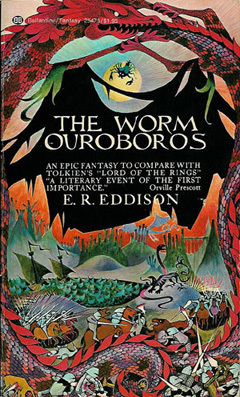
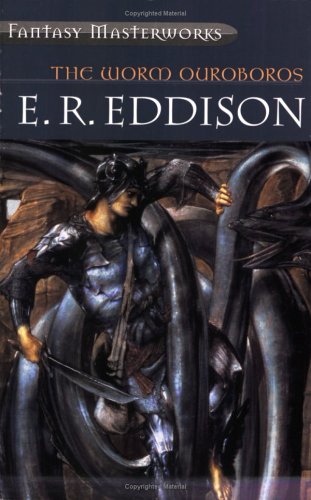
The Worm Ouroboros

by E.R. Eddison

The Worm Ouroboros! It goes around and around and around... and back around again!

2910This is the story of the Lords of Demonland, their arch-foes the Lords of Witchland, various others (Lords of Goblinland and Impland and Pixyland et al), and their endless conflicts and political maneuverings and deeds of derring-do and black-hearted villainy and mystical quests into the heights of dark mountains and women so awesomely beautiful that it means instant infatuation and fearsome magic that swoops down on both victim & conjurer alike and battles at castle gates and battles at sea and battles, battles, battles. Don't think of "Demons" and "Witches" as, well, demons and witches... those are just words used to describe the superhuman residents of the planet Mercury. The entire book is over the top, larger than life: delirious fantasy pitched to operatic heights, filled with ornate description, stylized dialogue, far-flung dream journeys and dreams of ever more glory. The Worm Ouroboros is an intricately designed relic and a work of strange, byzantine splendor.... This Mortal Coil as a grand and never-ending odyssey of Constant Adventure. I have read nothing like it.

3249086If I were to look at the plot alone, this would be an amusing but probably rather forgettable book. The narrative is an enjoyably breathless series of scenes full of cliffhangers and courtly intrigue. Fun. But also deeply problematic in a couple ways. The first problem: this book appears to glorify war in the most naive way imaginable: an endless boys' adventure where fighting is always the goal and peace is never the solution. The title and the "ending" in some ways subvert this analysis. I don't know how ironic or critical Eddison intended to be, but the basic idea of endless adventure being an self-perpetuating cycle... that does provide a certain depth as well as an ambiguous response to all of the naivete on display. More problematic is the near complete focus on the aristocrats of the world, enacting their grand battles using thousands upon thousands of common folk as their disposable chess pieces. One aristocrat dies - oh the tragedy! A thousand soldiers die in one minor sally - eh, that was a bad loss but whatever, the game must go on. There is something obviously very wrong about that kind of glorification of battle for battle's sake, no matter the cost. So for an action-packed narrative that is also naively offensive: 3 stars for the fun and 3 stars for the lack of humanity.

But what makes this novel uniquely enjoyable is the language. It truly lifts The Worm Ouroboros to a higher place. It was both a constant delight and a constant challenge. The language itself is highly artificial - archaic even; the descriptive passages are dense, complex, luscious; the heroes and the villains are characterized in the most Olympian terms possible; the Nietzschean morality on display is illustrated with an almost feverish passion;  there is a swooningly homoerotic vibe in how the men are depicted; the arch displays of humor and mockery are both sneakily subtle and quaintly broad; a quest by one brother searching for another becomes dreamily transcendent through the author's use of hallucinogenic prose. It is all so intense that it becomes hypnotic. Fully engorged testosterone carefully wrapped up in layer upon layer of dainty filigree and velvety shadow. High Fantasy that is as high as a kite. I smoked it all up; the language often put me to sleep but, just as often, it kept me wide awake with a kind of heady glee. It stimulated parts of my brain that hadn't been stimulated before.

Here is a typically odd, amusing, and rather beautiful passage:

1234891So speaking, the King was come with Gro into his great bath chamber, walled and floored with green serpentine, with dolphins carved in the same stone to belch water into the baths that were lined with white marble and sunken in the floor, both wide and deep, the hot bath on the left and cold bath, many times greater, on the right as they entered the chamber. The King dismissed his attendants, and made Gro sit on a bench piled with cushions above the hot bath, and drink more wine. And the King stripped off his jerkin of black cowhide and his hose and his shirt of white Beshtrian wool and went down into the steaming bath. Gro looked with wonder on the mighty limbs of Gorice the King, so lean and yet so strong to behold, as if he were built all of iron; and a great marvel it was how the King, when he had put off his raiment and royal apparel and went down stark naked into the bath, yet seemed to have put off not one whit of his kingliness and the majesty and dread which belonged to him.
 
So when he had plunged awhile in the swirling waters of the bath, and soaped himself from head to foot and plunged again, the King lay back luxuriously in the water and said to Gro, "Tell me of Corsus and his sons, and of Laxus and Gallandus, and of all my men west over seas, as thou shouldest tell of those whose life or death in our conceit importeth as much as that of a scarab fly. Speak and fear not, keeping nothing back nor glozing over nothing. Only that should make me dreadful to thee if thou shouldn't practise to deceive me."

A shout-out for Lord Gro: a sinister and devious Goblin Judas, a dainty dandy and a star-struck dreamer as prone to flights of romantic fancy as he is to fits of melancholy and despair, inconstant as Hamlet, destined to forever betray his masters, villain and hero, a gloriously unique creation. Go, Gro, Go!

And So: If thou shalt drink deep of the pleasures of language, if thou dost seek fearsome challenge brimming o'er with fantastickal wonder, dread enchantements and treacherous peril... then thou must hasten to consume this rare delight! A lovely treasure, burning boldly, ever-bright!

Saturday, August 31, 2013

Chronicles of the Black Company

by Glen Cook

"Oh, 'twould be marvelous if the world and its moral questions were like some game board, with plain black players and white, and fixed rules, and nary a shade of grey."

war is hell. hell is other people. other people are other people. other people have their problems. i have my own problems. my people are my people. their goals are my goals. we do what we can. we fight in a war. war is a business. war is our business.

The Black Company is a mercenary outfit. they are from the South; they currently work in the North. they fight for the Lady. they fight against the Rebel. they fight against the Lady. they fight for the White Rose. they fight for the Lady again. they fight for evil, they fight for good. they fight for who pays them. they fight against those who are against them. they do terrible things. they do some good things too.

400924Glen Cook was in the military. he understands what could be called the military mindset, i suppose. his characters feel completely real. they feel like real soldiers. they are cynical; they follow orders; their first loyalty is to each other. Cook writes in choppy, abrupt, stripped down prose, like a journalist writing on-the-spot field reports. his prose is not rich or lyrical, it does not glow, it does not leap off of the page. his characters have names like "Croaker" and "Darling" and "Shed" and "One-Eye". his cities have names like "Rust" and "Oar" and "Opal" and "Roses". there is a crude poetry to his prose. it is perfectly suited to what this series is trying to accomplish.

i read some reviews of this series before writing this review. a regular complaint is the lack of beauty in Cook's naming of people and places; a certain lack of fantastickal whimsy or majesty in the writing itself. SWOOSH, you are missing the point. The Black Company series is indeed pure fantasy - it contains magic and monsters and wizards and epic battles involving magic, monsters, and wizards. and yet its goal appears to be to reduce all the lavish world-building and all of the lustrous magic within those fantasy elements in service of making something that actually feels real. something that feels dark and dirty, and yet because of that dark dirtiness, something that also feels alive and warm. Cook does not write with a flair for microscopic detail; he does not envision his characters as having larger-than-life personalities or operatically tragic narrative trajectories. he is not George RR Martin. nor does Cook write with snarky, sizzling wit or an eye for the cinematic action sequence or a need to surprise the reader with various malevolent sucker punches. he is not Joe Abercrombie. he writes from a ground-eye view, from a working man's perspective, through the eyes of people who are neither all good nor all bad, but who are just trying to do what they can with what they have been given. they want to get paid, they do not hunger for danger, they want to make their lives a little better. so when the realization dawns that these disreputable, shady, completely fallible characters are trying to accomplish some good with what little they have available... well, it is a beautiful thing. if shades of grey can be considered a beautiful thing.

and he doesn't just do this for his soldiers. the third book portrays a powerful god-tree as a being who is just trying to do a job that needs to be done. he's grumpy about it. he is not particularly sympathetic to other people's problems. he's a good guy, apparently - but a disinterested one. after all, he has to focus on his own work. the series also features a rather loathsome innkeeper and various malevolent sorcerers and tyrants. they get the same treatment... after all, who is a villain in their own mind? the eventual realization that a loathsome innkeeper and a terrible sorceress-tyrant are also trying to do what little good they can accomplish comes slowly and is mapped out carefully, hints dropped nonchalantly, an accumulation of evidence. Cook does not push this revelation on the reader... it just is what it is. and so characters like Shed the Innkeeper and the tyrant known as the Lady - much like soldiers with names like Elmo and Croaker and the Captain and the Lieutenant - become real in a way that i have seldom seen accomplished in other works of fantasy.

great job, Cook. no wonder your series is such a cult classic.

although i think the first novel in the series is clearly the strongest, the entire trilogy is certainly a worthy experience. if you are in the right mindset, if military fantasy doesn't bother your more progressive sentiments, if you actually don't need things like sentiment in your fantasy.

Wednesday, August 21, 2013

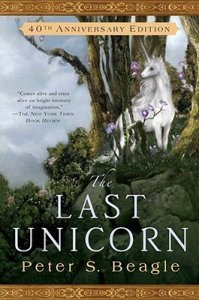
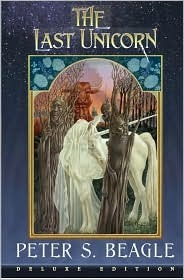
The Last Unicorn

by Peter S. Beagle

13124003so i set the mood for rereading The Last Unicorn by putting together a nifty mix of woodstock era classics, heavily featuring the likes of jethro tull & canned heat & richie havens & a lot of early pink floyd. i put on my comfy clothes. i brewed some tea. i picked my sunniest room and my cat - sensing my mood - snuggled in close. however, i did not smoke any weed. perhaps this was my mistake? nonetheless, the mood was definitely set and the enjoyment swiftly commenced.

this is a nice little book. it's sweet and cheeky and full of a kind of idealistic purity. it is very counter-culture in its quiet way. i was reminded constantly of things like Harold & Maude and King of Hearts and the Yellow Submarine and Jonathan Livingston Seagull. and of laying out on the grass with my friends during college in the 90s, happily on drugs and talking about life. it made me think of flowers and sunshine and animals that i like. this is certainly not a trippy book, but it is a pleasantly mellow one in tone and outlook. the writing is similarly warm and fuzzy. characterization is relaxed; living metaphors for freedom & authority & purity & greed & experience are mixed and matched in a loose, breathable fashion. the entire endeavor is what one would call a warm and human experience. i can see why this book has so many admirers and why it has apparently never been out of print. reading it is like reading a modern fable - it feels instantly classic, automatically timeless. and hopefully its beautiful messages about life and how to live it will never go out of style.

29127my favorite parts came early and then at the very end. the final standoff between our heroes and the Red Bull was very well done and genuinely gripping. even better was the time spent in Mommy Fortuna's horrible caravan. that was awesome! the descriptions of the different ensorcelled beasts, the dreaming spider, Schmendrick's introduction, Mommy Fortuna herself (such a poisonous yet rather sad & pathetic character), Mommy Fortuna as Old Age, and of course the terrifying, brilliantly rendered harpy... all quite delectable.

it's interesting to me to think about my two different reactions to the book: now and then. "then" was back in junior high, i think. i LOVED Schmendrick and found Molly Grue to be an annoying, tedious character. despite her, i loved the book from beginning to end. the beauty of its ultimate meaning (whatever that may have been to my 14-year old self) had me thinking about life and how to live it. many, many years later - yesterday! - i found Schmendrick to be distinctly annoying and Molly Grue to be the secret hero of the novel. this grouchy, critical, often overbearing middle-aged lady is also brave, honest, decent, completely down to earth - and such an unusual character to find as a lead in a fantasy novel. go, Molly, go! unfortunately, i also found myself to be positively un-charmed by all the anachronisms and whimsy. all that stuff just felt dated, goofy, sorta cheap. like that fookin butterfly for chrissakes. so unfunny. and judo. and "last of the red-hot swamis". and much more. ugh!

2033584
still, a lovely book with a timeless message. although i found those whimsical anachronisms to be obnoxiously precious & cutesy-poo, overall they didn't end up being too dire and my experience was not remotely ruined. hell, i roll my eyes at my closest friends and i still enjoy their company. so i did like The Last Unicorn quite a bit. it is sweetly appealing and genuinely charming.

Wednesday, July 3, 2013

Kushiel's Dart

by Jacqueline Carey

once upon a time, in response to the question What Would You Like To See In Fantasy, i responded:

1. i would like to see an old woman as a protagonist.
2. or an interesting demon - but not a 'sexy' PNR demon.
3. or more epic fantasies set in steamy, wet jungles rather than european-style forests or meadowlands.
4. or a YA fantasy series in which the hero grows progressively more villainous.

5. or a hero who is also a slut (male or female)
________

Kushiel's Dart (Phèdre's Trilogy, #1)i felt confident that Kushiel's Dart would allow me to eliminate number 4. alas, 'tis not to be. Phedre is no slut. i don't care how much Jacqueline Carey tries to convince us otherwise, the girl is no slut.

let me just start off by venting my confusion. okay, in this world, Phedre is an anguisette, which means that she gets off on (1) any sexual contact OR (2) PAIN, the kind experienced by a submissive during an s&m scenario. i put the OR in there because the novel can't seem to make up its mind which kind she is! that was really frustrating. if it was the first kind, well, bravo, i guess. i suppose that would make her a kind of natural-born slut, and that's awesome for her, no judgments whatsoever. you go, get it on, girl.

but she's not a natural-born slut - nope, not really. she doesn't get hungry at the sight of a cute lad or lassie - she just doesn't have that kind of slutty appetite. i think someone who is chemically castrated may actually have more horniness than Phedre.

so maybe it is the latter... PAIN! but then i bumped into a bit of underlying ridiculousness there that i just couldn't wrap my little mind around. the novel takes, um, great pains to note that Phedre is the first of her kind in 3 generations to have such exquisite receptiveness to PAIN. apparently other folks couldn't possibly enjoy any level of pain, not ever - not even the subs of the Harlot House dedicated to servicing sadists. really? seriously? what kind of world is this, Narnia? the Lollipop Land? Shannara? i just found that to be entirely naive, and therefore annoying. having genuine responsiveness to or enjoyment of a certain degree of pain in sex, let alone within an s&m or even rough sex scenario, is not exactly the rarest of sexual attributes. perhaps this strange lack of a not-uncommon ability, one that is actually rather widespread, is why this novel would be shelved within the Fantasy genre. what next - a fantasy world where no one's heard of doggy style?

okay, i guess i should actually review the book:

the first third of the novel is excellent! some excellent world-building, a sophisticated take on religion, and the emphasis on both politics and alternate sexualities was pleasing. the sex scenes were alternately graphic and subtle - i liked that, it lessened the monotony that comes with constant sexual description. the story was different things at different times: a coming of age tale; a novel of political maneouvering, treachery, and deceit; an elegant and erotic series of escalating sexcapades. Phedre & Delaunnay & Joscelin & Hyacinthe were all fun and enjoyable characters. overall, the country of Terre d'Ange is a fascinating place. if i were nobility, i would like to live there!

two quibbles:

first: the novel becomes rather annoyingly repetitious when trying to convince the reader that Delaunnay is so much more than a glorified pimp and that Phedre is totally fine with whoring herself out, no prob at all... it remained somewhat unconvincing. but maybe that's just my non-fantasy world perspective speaking.

second: all doms were portrayed as at least semi-villainous, and brutal beyond the bedroom as well. OH COME ON JACQUELINE CAREY! that just isn't fair. Joscelin - a man who clearly needs to more successfully sublimate his anger - should have the wherewithal to top Phedre, and he's no bad guy. come on Jos, get with the program! you too, Jacqueline Carey.

sadly, the rest of the novel was just okay, and it paled in comparison to the originality of the first third. there was nothing new, just alternate fantasy versions of the early germanic tribes, early england, early ireland. the pages turned quickly but that feeling of reading something very different evaporated quickly. the ending... eh. i kinda got tired of everyone practically shitting themselves at the awesomeness of Phedre. and "Phedre's Boy's".... ugh, that's so corny. and the use of magic, whether it be the dromonde or the "Master of the Straits" was unconvincing, abrupt, and just rather amateurish. ah well.

overall, the writing was above average. at times flowery, but that fits the novel. and there was enough promise in that first third that i'll probably take a chance on the second book. it would pain me to not find out where Phedre's freaky future sexploits take her.

Sunday, June 9, 2013

The Curse of Chalion

by Lois McMaster Bujold

The Curse of Chalion (Chalion, #1)when i was younger, i was always confused by the moniker of "Adult Fantasy" (less used today, but more common decades ago). i assumed it meant sex and possibly violence, but that was almost never the case... what it ended up meaning to me was BORING, I Can't Finish This.

well now that i am clearly an adult, i get it. for example, Curse of Chalion. this is definitely an Adult Fantasy. it does not feature sex - if anything, it is rather pleasingly old-fashioned and discreet about sex. and it does not feature extreme violence - the violent moments are just that, 'moments', and there is no juvenile dwelling on the pornography of blood, guts, & pain (although there is definitely blood, guts, and pain in our protagonist's life).

Curse of Chalion is Adult Fantasy in a few ways.

The Curse of Chalion (Chalion, #1)first, it is all about the interior life and the slow-burning changes in a broken man. he is a man in constant turmoil - one who lives in fear due to his tormented past and the betrayals that haunt him, one whose path appears to be a slow, step-by-step attempt at staying under the radar while looking out for the interests of those he loves. Cazaril is a hero, but not an easy one. action is not his automatic response (and so when it does occur, it is genuinely thrilling). the reader will find little knee-jerk wish fulfillment in his carefully-considered feints & moves. he is one of the most thoughtful protagonists i've come across in fantasy and a truly Grown Up, Adult Hero.

second, the pacing is very deliberate. this is not a novel where action jumps off the page in a big rush. it moves at a conservative pace, bringing the reader along on Cazaril's slow journey. it forces you into understanding what makes the man, why he acts the way he does, before finally picking up the pace and beginning Adventure Time - if you can even call such a thoughtful progression An Adventure. it seems almost purposefully designed to throw off the rather shallow needs of the thrill-seeking reader (and i include myself in that group). the book is thoughtful.

The Curse of Chalion (Chalion, #1)third, religion is front and center. there is magic in Curse of Chalion - Death Magic even - but it is linked entirely with the worship of 5 gods & goddesses. it is a painful sort of magic. it is a deep and rich and nuanced portrait of religion. i loved it. the novel's intense and nuanced focus on faith and spirituality was my favorite part of the experience.

and finally, it features the inclusion of a major supporting character who is queer. it did not feel arbitrary, the character is not there as some form of liberal tokenism, there was no stereotypical nonsense to annoy me, and the character and his actions are completely organic to the story - he is not shoe-horned into the narrative. as a queer, i really appreciate this sensitive, realistic, and exploitation-free approach.

Sunday, May 5, 2013

The Book of Lost Things

by John Connolly

Fugue state, formally Dissociative Fugue... usually involves unplanned travel or wandering, and is sometimes accompanied by the establishment of a new identity. Fugues are usually precipitated by a stressful episode.
 
The Book of Lost Thingsin world war 2-era england, young David loses his mother after a lingering illness and begins to experience strange dissociative episodes, often involving the sounds of books whispering to him and usually ending with him falling into unconsciousness. soon enough, his father finds a new wife named Rose - a nurse at his mother's hospice - and David finds himself with a stepmother and an infant half-brother. David is deeply unhappy with this development. after the new family moves out of london to Rose's country home in order to escape german bombers, David realizes a shadowy, crooked figure has sinister designs on him and his brother. one night, after a particularly bad argument with his folks, David hears his mother's voice calling him. following that voice, he crawls into a hole within a sunken garden - just as a german bomber also falls from the sky and crashes into that garden. he emerges into a sinister fantasyland. his quest: Find and Rescue His Mother. his nemesis: The Crooked Man.
 
John Connolly is best known as a respected writer of an excellent detective series. his strengths have been widely reported: gorgeously dark and lush descriptive skills, a sensitive portrayal of private eye Charlie Parker - an unusually tormented protagonist (tragic even for a genre noted for its sad, sad heroes), and a unsettling ability to mix the prosaic with the supernatural to startling effect. in this book, Connolly takes each of those gifts and streamlines them in a way that is appropriate for the reader of young adult or even children's literature - although this novel is very clearly an Adult Fairy Tale. the result is pleasingly distinctive. there are many scenes that are striking in their psychosocial nuance, their foreboding atmosphere, their ability to evoke that wonderfully shivery feeling of fearful anticipation. my favorite passage happens early on: David's daunting entry into the strange fantasy world... an eerie vignette that is a model of careful, suspenseful writing, featuring unearthly quiet, child-like flowers, a a taciturn Woodsman, the smoking remains of the german bomber, bleeding trees, a house in the woods with a Giger-like exterior, and a gathering of evil wolfish beings.
 
Dionysian imitatio, a literary method of imitation conceived as the practice of emulating, adaptating, reworking and enriching a source text by an earlier author.
 
 Book of Lost Things is a book of mythopoeic templates - revisited, revised, regurgitated, remixed, and reimagined. we have an entire company of Big Bad Wolves, reconfigured as ambitious wolf-men, born of a grotesquely slutty Little Red Hood and sprung from the nightmares of a juvenile king... a perhaps not-so-Wicked Stepmother... a malevolent and terrifying Sleeping Beauty... Childe Roland, transformed as a brave gay soldier in search of his long-lost lover... trolls and harpies and a savage, hungry Beast... a young girl's spirit in a glass jar... and our villain, a gleeful child-thief, a striker of dark bargains, a Rumpelstiltskin, an old old devil: The Crooked Man.

the use of revisionism is, sadly, not always successful. a comic interlude with the socialist Seven Dwarves and an obese, monstrous Snow White is depressingly unfunny and a little desperate (at least to this reader). and a long part near the end, depicting various torture chambers and examples of The Crooked Man's terrible villainy seems to be merely an excuse for Connolly to indulge himself with a gloatingly vicious array of sadistic tableau. both sequences were eye-rolling and sigh-inducing.

but those are aberrations; despite them, Connolly more than succeeds in creating delightful and intriguing reinterprations of figures from fairy and folk tale. even better, David's character is a slow-burning but dynamic one, changing in bits and starts from boy to man with each new encounter. he is a realistically flawed protagonist as well as a brave and endearing little hero.

Memento mori, a Latin phrase translated as "Remember your mortality", "Remember you must die" or "Remember you will die"... it names a genre of artistic work which varies widely, but which all share the same purpose: to remind people of their own mortality.

the novel's extended endings were a brilliant surprise. to avoid spoilers, i'll just say that i was entirely taken aback by the meaning of The Book of Lost Things itself. and - even more memorably, more intensely - the closing pages' no-nonsense illustration of the potential and/or inherent tragedy of human life in general... and the idea of that tragedy - no matter how intimate - somehow not really being that tragic at all - just simply a part of the greater cycle of life, death, and rebirth.

i hate to end a review with a tv show reference... but if you have ever seen the last 10 minutes or so of Six Feet Under's final episode - a wondrously sad, wistful, yet somehow uplifting experience - you will know exactly what i mean. the ending of this rather fantastic book is equally moving.

Saturday, March 30, 2013

Little, Big

by John Crowley

Little, Big

sometimes, when dreaming, i am aware of a complex and mysterious history to the at times strange but often mundane narrative of the dream itsef. i'll be running away from something, against some dark background, a house or castle or a school, who knows... although the drama of running is clear, there's often a feeling that so many things have already happened before i started running, things of which i'm only dimly aware, a whole story has happened or is happening in which i'm only getting bits & pieces or what feels like the end. i guess it's what makes some dreams so hard to explain - simple or inexplicable events occurring that have an emotional depth and meaning that is near impossible to describe in passionless terms.

other times, passing by my work's drop-in center, i'll exchange words with a visitor, a person usually dealing with life changes or the possibility of life ending (that's the nature of my workplace). they'll say some simple pleasantry or even give a brief phrase to show how they're doing... and there's a whole world in what they say, an entire journey expressed, near-tangible emotions conveyed. but of the details of that history, the why and how of it, and the place they seek or the place they fear to go... inexpressible.

that's what reading Little, Big was like for me. so many little moments in a family's life, in the lives of people connected to the family, in the city in which the family dwells. and all these moments live in a world with a background and a future that is vast, mystical, dreamlike, one that cannot be expressed with any kind of logical or linear description. sometimes the moments are so personal and delicate... other times they are whimsical and brimming with magic, or strange and full of some kind of barely understandable threat... sad moments, and tragic ones, and moments filled with delight... and in the end, they become grand and they sweep the characters and the reader towards what almost feels like an understanding of the purpose and destination of it all. almost!

the novel is about an enchanted family, their loves & lives & history. it is also about the end of an age, the beginning of another, witches & changelings & fairies & enchantments, loneliness & forgetfulness & sorrow, love, the past and the future, and new york city. there are no real villains, there are no traditional heroes. the writing has a dense but fragile beauty. there are layers upon layers. there are mythical beings that come alive and realistic characters that become as myths. i sighed in amazement, many times, at the wonder of it all; it is like a dream made half-real. it is a unique book.