by Zoe Archer
 he is an EX-SOLDIER!
she belongs to a SECRET SOCIETY!
this is a ROMANCE!
but it has a lot of ADVENTURE!
and MAGIC!
in MONGOLIA!
I liked all of that MONGOLIA!
she's no prude she wants to be an ADVENTURESS!
and also his WIFE!
he's your basic decent studly alpha male STEREOTYPE!
his eyes, his skin, his hair are colored in shades of GOLD!
he apparently smells like the WIND!
she is an accomplished ARCHER!
she really knows how to use a GUN!
also, she sure knows how to ride a HORSE!
the story was like a classic fast-paced ADVENTURE MOVIE!
the feel of this book is decidedly OLD-FASHIONED!
except he frequently mentions his stiff COCK!
he is an EX-SOLDIER!
she belongs to a SECRET SOCIETY!
this is a ROMANCE!
but it has a lot of ADVENTURE!
and MAGIC!
in MONGOLIA!
I liked all of that MONGOLIA!
she's no prude she wants to be an ADVENTURESS!
and also his WIFE!
he's your basic decent studly alpha male STEREOTYPE!
his eyes, his skin, his hair are colored in shades of GOLD!
he apparently smells like the WIND!
she is an accomplished ARCHER!
she really knows how to use a GUN!
also, she sure knows how to ride a HORSE!
the story was like a classic fast-paced ADVENTURE MOVIE!
the feel of this book is decidedly OLD-FASHIONED!
except he frequently mentions his stiff COCK!
by James Jones
A true masterpiece and one of my favorite novels. Although it has all the realistic, gritty detailing that any novel recounting World War 2 Guadalcanal should have, it is so much more. The reader will indeed learn which gun is which and which rank is which. They will understand what needs to happen to take a hill. They will know what a crowded ship full of men will smell like. They will come to understand the practical intricacies of making war. But, as anyone who viewed the recent version of the film will know, the story is not one based on narrative but one based on a specific philosophy: we are all, as humans, forever destined to never truly understand one another, we are forever destined to never truly achieve the kind of empathetic meeting of heart & mind & soul that we may yearn for - a yearning we may not understand or even recognize. War is, if it is anything, an insane metaphor for that lack of understanding, that true lack of connection, and to be a part of that metaphor is to be, in a way, as insane.
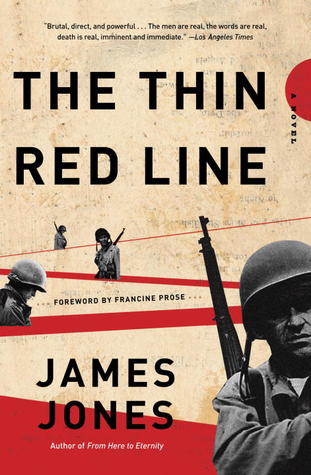
This is a novel of many voices, each individualized and each specifically unique and amusingly detailed. And yet there is a similarity to the themes that emerge from the thoughts of each of the characters, whether they are trying to understand their brothers, their girls back home, their commanders, their enemy, their next target, or the war itself: the feeling of distance. It is a melancholy and confusing feeling. Each one blunders through his life in his own way, barely grasping what is happening around him, barely grasping what is happening inside himself as well. The novel is epic in its depiction of war, but it is intimate in its depiction of the levels of mystery within each of us and between us as well.
It is surprisingly funny at times. James Jones has a mordant voice and he knows the ridiculousness of men, how amusing our little concerns and irritations and idiosyncrasies can be when depicted at times gently but more often pointedly. He also knows that throwing dozens upon dozens of characters in the narrative will confuse and annoy the lazy reader – but how else to illustrate the confusion of wartime? The coming and going of bodies, of places, of times that all blur together. Jones himself was a WW2 veteran, and so the details are impressively laid out – but what is even more impressive is the poetic, sorrowful mourning that is suffused throughout the novel, one that builds and builds and builds. It is hard to imagine the number of his fellows he saw slain, and how it impacted him. But beyond that, to see the melancholy within the man, not just the soldier, not just the circumstance? He is the rare author I would love to have known, and yet the idea of his experience and his sadness is so intimidating, it makes me feel like less of a grown man when thinking of the person who could write all of this down. What have I done in my life in comparison?
It is interesting to compare the film with the novel. The theme of the distance between humans is there, as is the idea of many narrative voices recounting many different things but all ending in despair over our lack of ability to truly understand ourselves, the world, each other. But Malick widens the melancholy even further by including his usual theme of man’s distance from nature as well. It works beautifully. Two character differences stand out: Pvt Witt and Cpl Fife.
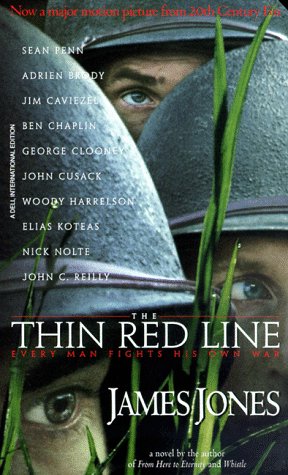 In the film, Pvt Witt is played by James Caviezel as a beatific savior of men, spiritually connected to nature and prone to daring displays of bravery. In the novel, Witt is a spiteful hick, also prone to daring displays of bravery, but also an unrepentant racist towards all non-whites, and is filled to the brim with petty contempt towards all forms of authority. I like both portraits, but the novel’s Witt seems so much more human, so much more real. You don’t have to be a saint or even particularly likeable to be brave, to save lives, to accomplish daring deeds, to be loveable. He is a hero, ignorant redneck and all, precisely because he is not particularly heroic in thought – only in deed. He comes through, again and again.
In the film, Cpl Fife is reduced to a couple cameos by Adrien Brody, standing distraught by a soldier’s corpse or looking terrified during a river crossing. In the novel, he is so much more: a dissection of the falseness of the concept of “cowardice” during war. He is full of fear, he calls himself a coward, each path he chooses is one that has self-protection at its core; and yet his depiction is entirely sympathetic and rational: what sane man isn’t a coward when it comes to the insanity of war? Who wants it, who wants to be in it? It is not something to run to, it is something to run from. Fife is the secret hero of The Thin Red Line, the rational man not understanding the irrational world around him, and rejecting any attempt to bend him to that irrational world’s rules. I can see how that character would not translate successfully to audiences yearning for heroes, and so Fife in his entirety barely makes it to the screen.
The book’s great success may not just be in its depiction of the distance between humans, but in the illustration of war as the ultimate insanity. As we all know, World War 2 was the Good War, the one in which we all should be proud, the one with truly golden heroes and truly evil villains, the one we all are glad was fought and would have fought in if we could. We had the right reasons after all; at least that is my own perspective. But a good war is still war, and war entails the deaths of the young, the destruction of lives and of love, of cities and of countryside, of innocence, of tradition, of everything. So why do we love it so?
In the film, Pvt Witt is played by James Caviezel as a beatific savior of men, spiritually connected to nature and prone to daring displays of bravery. In the novel, Witt is a spiteful hick, also prone to daring displays of bravery, but also an unrepentant racist towards all non-whites, and is filled to the brim with petty contempt towards all forms of authority. I like both portraits, but the novel’s Witt seems so much more human, so much more real. You don’t have to be a saint or even particularly likeable to be brave, to save lives, to accomplish daring deeds, to be loveable. He is a hero, ignorant redneck and all, precisely because he is not particularly heroic in thought – only in deed. He comes through, again and again.
In the film, Cpl Fife is reduced to a couple cameos by Adrien Brody, standing distraught by a soldier’s corpse or looking terrified during a river crossing. In the novel, he is so much more: a dissection of the falseness of the concept of “cowardice” during war. He is full of fear, he calls himself a coward, each path he chooses is one that has self-protection at its core; and yet his depiction is entirely sympathetic and rational: what sane man isn’t a coward when it comes to the insanity of war? Who wants it, who wants to be in it? It is not something to run to, it is something to run from. Fife is the secret hero of The Thin Red Line, the rational man not understanding the irrational world around him, and rejecting any attempt to bend him to that irrational world’s rules. I can see how that character would not translate successfully to audiences yearning for heroes, and so Fife in his entirety barely makes it to the screen.
The book’s great success may not just be in its depiction of the distance between humans, but in the illustration of war as the ultimate insanity. As we all know, World War 2 was the Good War, the one in which we all should be proud, the one with truly golden heroes and truly evil villains, the one we all are glad was fought and would have fought in if we could. We had the right reasons after all; at least that is my own perspective. But a good war is still war, and war entails the deaths of the young, the destruction of lives and of love, of cities and of countryside, of innocence, of tradition, of everything. So why do we love it so?
by Barry Gifford
 one sweaty afternoon in ensenada, jim thompson met flannery o'connor. the mutual attraction was immediate; they quickly retired to a local flophouse to bang it out. nine months later, a child was born: barry gifford. young barry inherited many of his parents' traits: from his prickly mom - a love of southern conversation and southern grotesquerie; from his laconic dad - a deep interest in how trashy, often deeply amoral sorts can get themselves involved with some heavy business. but the boy was also his own man, and instead of espousing the moralism of his mama or the nihilism of his daddy, he found his own path: to vividly illustrate the lives of low-lifes... but to stop just short of turning them into toxic aliens. give them healthy, sex-positive attitudes; give them amusingly quirky conversational tics! maybe even give them a happy ending. the world is scary and deadly - but it can be fun too!
the novel is a continuation of the adventures of Sailor and Lula, perhaps most famous as the protagonists of david lynch's bizarre extravaganza Wild at Heart. Sailor's Holiday is actually a collection of four interrelated novellas. despite how strong the violence and sadism can occasionally get, they are all rather lightweight and charming. they also introduce one of my new favorite characters, Sailor and Lula's sweet, fearless son - Pace Ripley. he's great. his character is central in two of the stories, once at around age 10 and then at age 15. this kid is a marvel under pressure, despite being involved in some sordid doings and being kidnapped two times by two different psychos. he keeps both his wits and his deadpan sensibility about him at all times. when we last hear of him, he is leading himalayan treks in nepal. despite his penchant for underage smoking and drinking, this is a son i'd be delighted to have.
"59° and Raining": the further adventures of scary-hot Perdita Durango and her new boyfriend Romeo Delarosa, as they embark on a bloody adventure full of kidnapping, ritual sacrifice, and placenta smuggling. this is the basis of the horrific film Dance with the Devil.
"Sailor's Holiday": Lula is busy raising little Pace and trying to find herself. Sailor finally gets out of jail. poor Pace gets kidnapped. hi-jinks ensue.
"Sultans of Africa": Pace starts hanging out with the sketchy Rattler twins. Sailor is finding his job at a gator repellent factory to be a mite challenging. Lula gets slightly involved in the revivalism of Reverend Goodin Plenty. poor Pace gets kidnapped again.
"Consuelo's Kiss": Sailor and Lula take a road trip to celebrate Sailor's 50th birthday. in a parallel plot, intrepid jailbait Consuelo Whynot takes a road trip to visit her mystic lover Venus. rumination and bloodshed follow.
it is almost unimportant to give details of the novellas themselves. the main thing about gifford's writing is that it is digressive. have you ever seen the truffaut film Shoot The Piano Player? in the beginning, the protagonist comes across a nice fellow who proceeds to tell his interesting but totally random story of love lost. random guy disappears and has nothing whatsoever to do with the rest of the movie. well, the same thing goes for this novel. there are plots and central characters, sure, but on every page we mainly read the stories, gossip, tidbits, facts, and effluvia of other characters, their lives and the way those lives ended. Sailor's Holiday is completely digressive in its storytelling. although the writing style is stripped-down, it is not tightly paced by any means. the best way i can describe the experience is to say that it is like sitting on a porch drinking beers on a hot day with old friends or interesting new acquaintances, shooting the shit and telling stories about all the crazy people we've known and the crazy stories we've heard, tales full of gallows humor, caricature, sex, blood, death, marriage, family, life. a pleasant way to spend an afternoon!
one sweaty afternoon in ensenada, jim thompson met flannery o'connor. the mutual attraction was immediate; they quickly retired to a local flophouse to bang it out. nine months later, a child was born: barry gifford. young barry inherited many of his parents' traits: from his prickly mom - a love of southern conversation and southern grotesquerie; from his laconic dad - a deep interest in how trashy, often deeply amoral sorts can get themselves involved with some heavy business. but the boy was also his own man, and instead of espousing the moralism of his mama or the nihilism of his daddy, he found his own path: to vividly illustrate the lives of low-lifes... but to stop just short of turning them into toxic aliens. give them healthy, sex-positive attitudes; give them amusingly quirky conversational tics! maybe even give them a happy ending. the world is scary and deadly - but it can be fun too!
the novel is a continuation of the adventures of Sailor and Lula, perhaps most famous as the protagonists of david lynch's bizarre extravaganza Wild at Heart. Sailor's Holiday is actually a collection of four interrelated novellas. despite how strong the violence and sadism can occasionally get, they are all rather lightweight and charming. they also introduce one of my new favorite characters, Sailor and Lula's sweet, fearless son - Pace Ripley. he's great. his character is central in two of the stories, once at around age 10 and then at age 15. this kid is a marvel under pressure, despite being involved in some sordid doings and being kidnapped two times by two different psychos. he keeps both his wits and his deadpan sensibility about him at all times. when we last hear of him, he is leading himalayan treks in nepal. despite his penchant for underage smoking and drinking, this is a son i'd be delighted to have.
"59° and Raining": the further adventures of scary-hot Perdita Durango and her new boyfriend Romeo Delarosa, as they embark on a bloody adventure full of kidnapping, ritual sacrifice, and placenta smuggling. this is the basis of the horrific film Dance with the Devil.
"Sailor's Holiday": Lula is busy raising little Pace and trying to find herself. Sailor finally gets out of jail. poor Pace gets kidnapped. hi-jinks ensue.
"Sultans of Africa": Pace starts hanging out with the sketchy Rattler twins. Sailor is finding his job at a gator repellent factory to be a mite challenging. Lula gets slightly involved in the revivalism of Reverend Goodin Plenty. poor Pace gets kidnapped again.
"Consuelo's Kiss": Sailor and Lula take a road trip to celebrate Sailor's 50th birthday. in a parallel plot, intrepid jailbait Consuelo Whynot takes a road trip to visit her mystic lover Venus. rumination and bloodshed follow.
it is almost unimportant to give details of the novellas themselves. the main thing about gifford's writing is that it is digressive. have you ever seen the truffaut film Shoot The Piano Player? in the beginning, the protagonist comes across a nice fellow who proceeds to tell his interesting but totally random story of love lost. random guy disappears and has nothing whatsoever to do with the rest of the movie. well, the same thing goes for this novel. there are plots and central characters, sure, but on every page we mainly read the stories, gossip, tidbits, facts, and effluvia of other characters, their lives and the way those lives ended. Sailor's Holiday is completely digressive in its storytelling. although the writing style is stripped-down, it is not tightly paced by any means. the best way i can describe the experience is to say that it is like sitting on a porch drinking beers on a hot day with old friends or interesting new acquaintances, shooting the shit and telling stories about all the crazy people we've known and the crazy stories we've heard, tales full of gallows humor, caricature, sex, blood, death, marriage, family, life. a pleasant way to spend an afternoon!
