
by Richard "I Really Don't Hate Myself Anymore I Promise You God, Please Don't Send Me to Hell" Cohen
sorry Richard, but


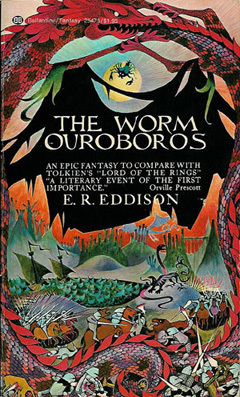 This is the story of the Lords of Demonland, their arch-foes the Lords of Witchland, various others (Lords of Goblinland and Impland and Pixyland et al), and their endless conflicts and political maneuverings and deeds of derring-do and black-hearted villainy and mystical quests into the heights of dark mountains and women so awesomely beautiful that it means instant infatuation and fearsome magic that swoops down on both victim & conjurer alike and battles at castle gates and battles at sea and battles, battles, battles. Don't think of "Demons" and "Witches" as, well, demons and witches... those are just words used to describe the superhuman residents of the planet Mercury. The entire book is over the top, larger than life: delirious fantasy pitched to operatic heights, filled with ornate description, stylized dialogue, far-flung dream journeys and dreams of ever more glory. The Worm Ouroboros is an intricately designed relic and a work of strange, byzantine splendor.... This Mortal Coil as a grand and never-ending odyssey of Constant Adventure. I have read nothing like it.
 If I were to look at the plot alone, this would be an amusing but probably rather forgettable book. The narrative is an enjoyably breathless series of scenes full of cliffhangers and courtly intrigue. Fun. But also deeply problematic in a couple ways. The first problem: this book appears to glorify war in the most naive way imaginable: an endless boys' adventure where fighting is always the goal and peace is never the solution. The title and the "ending" in some ways subvert this analysis. I don't know how ironic or critical Eddison intended to be, but the basic idea of endless adventure being an self-perpetuating cycle... that does provide a certain depth as well as an ambiguous response to all of the naivete on display. More problematic is the near complete focus on the aristocrats of the world, enacting their grand battles using thousands upon thousands of common folk as their disposable chess pieces. One aristocrat dies - oh the tragedy! A thousand soldiers die in one minor sally - eh, that was a bad loss but whatever, the game must go on. There is something obviously very wrong about that kind of glorification of battle for battle's sake, no matter the cost. So for an action-packed narrative that is also naively offensive: 3 stars for the fun and 3 stars for the lack of humanity.
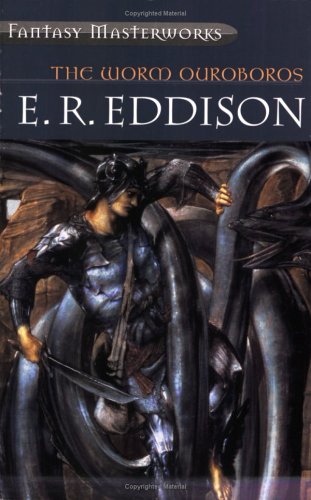 So speaking, the King was come with Gro into his great bath chamber, walled and floored with green serpentine, with dolphins carved in the same stone to belch water into the baths that were lined with white marble and sunken in the floor, both wide and deep, the hot bath on the left and cold bath, many times greater, on the right as they entered the chamber. The King dismissed his attendants, and made Gro sit on a bench piled with cushions above the hot bath, and drink more wine. And the King stripped off his jerkin of black cowhide and his hose and his shirt of white Beshtrian wool and went down into the steaming bath. Gro looked with wonder on the mighty limbs of Gorice the King, so lean and yet so strong to behold, as if he were built all of iron; and a great marvel it was how the King, when he had put off his raiment and royal apparel and went down stark naked into the bath, yet seemed to have put off not one whit of his kingliness and the majesty and dread which belonged to him.


