How mark monday Got Himself Placed on the Honors Track in High School and So Became a Smashing Success in Life... through Fighting and Lying!
in 9th grade, on my last day of school before moving from Virginia to Orange County (mid-school year), some joker told me that he was happy i was moving. so I grabbed my lunch tray and proceeded to bash it over his head repeatedly. I hate people who are discourteous!
in the Vice-Principal's office, I was told "This is the Last Time. You are Suspended for a week!"
to which I responded: "ha, ha, this is my last day, I'm moving to California tomorrow, stupid!"
and to which I was told: "We will hold your records until you have served your suspension, no matter where you go." ...Uh Oh
so I moved to Los Alamitos, located in beautiful, peaceful, sunny-beyond-belief Orange County, California. I went in to register for my new life, second semester 9th grade. I got my id, filled out the forms, was told to return in a week, when school started up again after the break.
but that next week, they were perplexed - for some reason, my old school wasn't sending me my records! and yet my old school was also not communicating (God Bless Administrators Everywhere) and so my new school did not know what was going on. the trusting administrators at Los Alamitos High then just went ahead and asked me this key question:
Why Don't You Just Tell Us What Classes You Were In?
it was a make-it-or-break-it moment. in Virginia, I was purely Average. I was average at being average. but I was struck with inspiration and decided to lie and put myself in all of the Honors Classes. Advanced English, Advanced This and That. and they believed me! I couldn't believe my good fortune.
so merrily I went to Mrs. Bennett's Honors English class. upon walking in, I noticed they were doing some foofy role-play about The Illiad - which i had read like 3 years earlier. I thought to myself man they saw right through me! I'm back in Average Classes.
ha, I quickly realized I was wrong! the academic standards in California were so low in comparison to Virginia (and South Bend, Indiana, where I went to school before Virginia), that Honors English was actually not just equivalent to regular ole English in those other states... it was actually far less challenging. goodbye, Average Kid. hello, new Straight-A Student!
***
Los Alamitos was the site of much controversy in the late 80s, when a School of the Arts (located within Los Al at the time) student was not allowed to exhibit her explicitly lesbian painting - unless it was covered up and the tagline "Let me live for the day when two women can love each other in peace" was changed to "Let me live for the day when two people can love each other in peace". Happily, the ACLU got involved and swinish school principal Carol Hart had to relent. Uncovered lesbianism on display at Los Al!
Los Al and its past teachers have been on my mind a bit.
one day in Mrs. Busenkell's Advanced Placement English Class for sophomores, we were given a typically bizarre assignment: pick a student, follow them around, study their actions, report back in an essay. Being the new Straight-A (well, not really) Go-Getter that I was, I chose to spy on 2 people. the first person, someone i liked. the scond person... an Ex-Friend. my report on him was scathing. lots of "he is a follower" and "he laughs at everyone's jokes like he wants a medal" and "superficial trend-lover" type comments. etc. Mrs Busenkell couldn't believe someone could write such a savage report on - get this - one of her son's best friends. so with typical Los Al professionalism, she shared my report with my Ex-Friend. what kind of teacher does that? apparently a Los Al kind of teacher, circa mid-80s. her decision to share one student's paper with another student exacerbated tensions between me and that Ex-Friend for years. he finally got around to telling me about it at a recent birthday, after I guess finally making peace with it some time ago. I had thought that paper was private and could never figure out why my old Ex-Friend never warmed up to me, even after we had resolved our differences. and so a potentially great friendship between two queer teens was nipped in the bud due to teacher shenanigans. believe me, my friend could have used some support - being a closeted gay teen was no picnic for him, while being queer has always been no problem for me. maybe I could have helped him not go down some rather questionable paths if that wedge hadn't been driven so deep.
hey Mrs. Busenkell, this one's for you!
Friday, September 20, 2013

Friday, September 13, 2013
The Worm Ouroboros
by E.R. Eddison
The Worm Ouroboros! It goes around and around and around... and back around again!
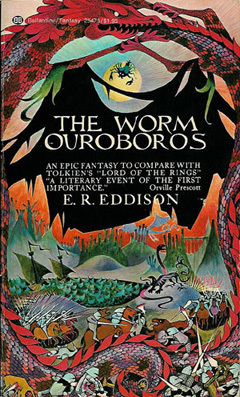 This is the story of the Lords of Demonland, their arch-foes the Lords of Witchland, various others (Lords of Goblinland and Impland and Pixyland et al), and their endless conflicts and political maneuverings and deeds of derring-do and black-hearted villainy and mystical quests into the heights of dark mountains and women so awesomely beautiful that it means instant infatuation and fearsome magic that swoops down on both victim & conjurer alike and battles at castle gates and battles at sea and battles, battles, battles. Don't think of "Demons" and "Witches" as, well, demons and witches... those are just words used to describe the superhuman residents of the planet Mercury. The entire book is over the top, larger than life: delirious fantasy pitched to operatic heights, filled with ornate description, stylized dialogue, far-flung dream journeys and dreams of ever more glory. The Worm Ouroboros is an intricately designed relic and a work of strange, byzantine splendor.... This Mortal Coil as a grand and never-ending odyssey of Constant Adventure. I have read nothing like it.
 If I were to look at the plot alone, this would be an amusing but probably rather forgettable book. The narrative is an enjoyably breathless series of scenes full of cliffhangers and courtly intrigue. Fun. But also deeply problematic in a couple ways. The first problem: this book appears to glorify war in the most naive way imaginable: an endless boys' adventure where fighting is always the goal and peace is never the solution. The title and the "ending" in some ways subvert this analysis. I don't know how ironic or critical Eddison intended to be, but the basic idea of endless adventure being an self-perpetuating cycle... that does provide a certain depth as well as an ambiguous response to all of the naivete on display. More problematic is the near complete focus on the aristocrats of the world, enacting their grand battles using thousands upon thousands of common folk as their disposable chess pieces. One aristocrat dies - oh the tragedy! A thousand soldiers die in one minor sally - eh, that was a bad loss but whatever, the game must go on. There is something obviously very wrong about that kind of glorification of battle for battle's sake, no matter the cost. So for an action-packed narrative that is also naively offensive: 3 stars for the fun and 3 stars for the lack of humanity.
But what makes this novel uniquely enjoyable is the language. It truly lifts The Worm Ouroboros to a higher place. It was both a constant delight and a constant challenge. The language itself is highly artificial - archaic even; the descriptive passages are dense, complex, luscious; the heroes and the villains are characterized in the most Olympian terms possible; the Nietzschean morality on display is illustrated with an almost feverish passion; there is a swooningly homoerotic vibe in how the men are depicted; the arch displays of humor and mockery are both sneakily subtle and quaintly broad; a quest by one brother searching for another becomes dreamily transcendent through the author's use of hallucinogenic prose. It is all so intense that it becomes hypnotic. Fully engorged testosterone carefully wrapped up in layer upon layer of dainty filigree and velvety shadow. High Fantasy that is as high as a kite. I smoked it all up; the language often put me to sleep but, just as often, it kept me wide awake with a kind of heady glee. It stimulated parts of my brain that hadn't been stimulated before.
Here is a typically odd, amusing, and rather beautiful passage:
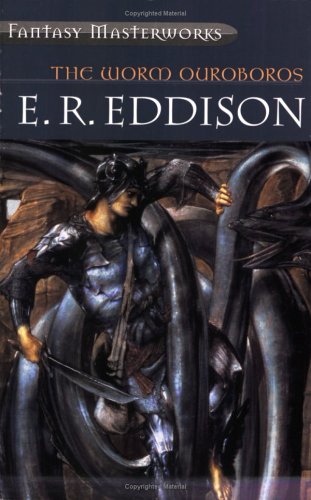 So speaking, the King was come with Gro into his great bath chamber, walled and floored with green serpentine, with dolphins carved in the same stone to belch water into the baths that were lined with white marble and sunken in the floor, both wide and deep, the hot bath on the left and cold bath, many times greater, on the right as they entered the chamber. The King dismissed his attendants, and made Gro sit on a bench piled with cushions above the hot bath, and drink more wine. And the King stripped off his jerkin of black cowhide and his hose and his shirt of white Beshtrian wool and went down into the steaming bath. Gro looked with wonder on the mighty limbs of Gorice the King, so lean and yet so strong to behold, as if he were built all of iron; and a great marvel it was how the King, when he had put off his raiment and royal apparel and went down stark naked into the bath, yet seemed to have put off not one whit of his kingliness and the majesty and dread which belonged to him.
A shout-out for Lord Gro: a sinister and devious Goblin Judas, a dainty dandy and a star-struck dreamer as prone to flights of romantic fancy as he is to fits of melancholy and despair, inconstant as Hamlet, destined to forever betray his masters, villain and hero, a gloriously unique creation. Go, Gro, Go!
The Worm Ouroboros! It goes around and around and around... and back around again!
This is the story of the Lords of Demonland, their arch-foes the Lords of Witchland, various others (Lords of Goblinland and Impland and Pixyland et al), and their endless conflicts and political maneuverings and deeds of derring-do and black-hearted villainy and mystical quests into the heights of dark mountains and women so awesomely beautiful that it means instant infatuation and fearsome magic that swoops down on both victim & conjurer alike and battles at castle gates and battles at sea and battles, battles, battles. Don't think of "Demons" and "Witches" as, well, demons and witches... those are just words used to describe the superhuman residents of the planet Mercury. The entire book is over the top, larger than life: delirious fantasy pitched to operatic heights, filled with ornate description, stylized dialogue, far-flung dream journeys and dreams of ever more glory. The Worm Ouroboros is an intricately designed relic and a work of strange, byzantine splendor.... This Mortal Coil as a grand and never-ending odyssey of Constant Adventure. I have read nothing like it.If I were to look at the plot alone, this would be an amusing but probably rather forgettable book. The narrative is an enjoyably breathless series of scenes full of cliffhangers and courtly intrigue. Fun. But also deeply problematic in a couple ways. The first problem: this book appears to glorify war in the most naive way imaginable: an endless boys' adventure where fighting is always the goal and peace is never the solution. The title and the "ending" in some ways subvert this analysis. I don't know how ironic or critical Eddison intended to be, but the basic idea of endless adventure being an self-perpetuating cycle... that does provide a certain depth as well as an ambiguous response to all of the naivete on display. More problematic is the near complete focus on the aristocrats of the world, enacting their grand battles using thousands upon thousands of common folk as their disposable chess pieces. One aristocrat dies - oh the tragedy! A thousand soldiers die in one minor sally - eh, that was a bad loss but whatever, the game must go on. There is something obviously very wrong about that kind of glorification of battle for battle's sake, no matter the cost. So for an action-packed narrative that is also naively offensive: 3 stars for the fun and 3 stars for the lack of humanity.But what makes this novel uniquely enjoyable is the language. It truly lifts The Worm Ouroboros to a higher place. It was both a constant delight and a constant challenge. The language itself is highly artificial - archaic even; the descriptive passages are dense, complex, luscious; the heroes and the villains are characterized in the most Olympian terms possible; the Nietzschean morality on display is illustrated with an almost feverish passion; there is a swooningly homoerotic vibe in how the men are depicted; the arch displays of humor and mockery are both sneakily subtle and quaintly broad; a quest by one brother searching for another becomes dreamily transcendent through the author's use of hallucinogenic prose. It is all so intense that it becomes hypnotic. Fully engorged testosterone carefully wrapped up in layer upon layer of dainty filigree and velvety shadow. High Fantasy that is as high as a kite. I smoked it all up; the language often put me to sleep but, just as often, it kept me wide awake with a kind of heady glee. It stimulated parts of my brain that hadn't been stimulated before.
Here is a typically odd, amusing, and rather beautiful passage:
So speaking, the King was come with Gro into his great bath chamber, walled and floored with green serpentine, with dolphins carved in the same stone to belch water into the baths that were lined with white marble and sunken in the floor, both wide and deep, the hot bath on the left and cold bath, many times greater, on the right as they entered the chamber. The King dismissed his attendants, and made Gro sit on a bench piled with cushions above the hot bath, and drink more wine. And the King stripped off his jerkin of black cowhide and his hose and his shirt of white Beshtrian wool and went down into the steaming bath. Gro looked with wonder on the mighty limbs of Gorice the King, so lean and yet so strong to behold, as if he were built all of iron; and a great marvel it was how the King, when he had put off his raiment and royal apparel and went down stark naked into the bath, yet seemed to have put off not one whit of his kingliness and the majesty and dread which belonged to him.
So when he had plunged awhile in the swirling waters of the bath, and soaped himself from head to foot and plunged again, the King lay back luxuriously in the water and said to Gro, "Tell me of Corsus and his sons, and of Laxus and Gallandus, and of all my men west over seas, as thou shouldest tell of those whose life or death in our conceit importeth as much as that of a scarab fly. Speak and fear not, keeping nothing back nor glozing over nothing. Only that should make me dreadful to thee if thou shouldn't practise to deceive me."
A shout-out for Lord Gro: a sinister and devious Goblin Judas, a dainty dandy and a star-struck dreamer as prone to flights of romantic fancy as he is to fits of melancholy and despair, inconstant as Hamlet, destined to forever betray his masters, villain and hero, a gloriously unique creation. Go, Gro, Go!
And So: If thou shalt drink deep of the pleasures of language, if thou dost seek fearsome challenge brimming o'er with fantastickal wonder, dread enchantements and treacherous peril... then thou must hasten to consume this rare delight! A lovely treasure, burning boldly, ever-bright!
Tuesday, September 3, 2013
Shades of Grey
by Jasper Fforde
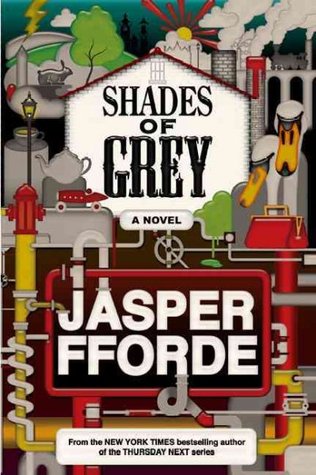 the world of Shades of Grey is a nightmarish dystopia: a ruthless totalitarian regime that destroys all individualistic spirit, all creativity and ambiguity and questioning of authority; a monstrous government that divides its citizens into color-stratified class/caste systems that is based upon the inherent physical deficiencies of its populace; a place with no love and where death is the end result for the underdog and misfit.
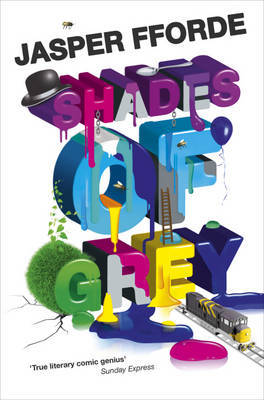 sounds pretty bleak, right? well, dear reader, think again! this rather amazing novel is as light and airy as a souffle, a real pleasure to consume from beginning to end. i was smiling constantly and laughing out loud nearly as often. the tone is brisk and drily amusing. the plot and the various details of our young hero's travails are wonderfully absurd: the punishment for his past cheekiness is to conduct a "Chair Census"; he must beware deadly carnivorous swans and "mega-fauna"; his greatest ambition is to be the head of a String Factory! upstairs from him and his dad lives the "Apocryphal Man" - an historian the state has deemed 'does not exist', and so is free to wander around naked, stealing food, muttering terrifying truths yet remaining unmolested. the love of his life is mean Jane - a Grey, the lowest caste - a rebel with a cause who does not hesitate to punish him drastically whenever he gets in her way.
 the writing itself is splendid. Fforde is a deadpan and satirical author with a perfect grasp of what to show, what to tell, what to keep hidden, and what to save for an exciting climax. i was reminded of several things when reading this book: the equally absurd and distinctly provincial post-apocalyptic settings of Dick's Dr. Bloodmoney and Miller's A Canticle for Leibowitz, and especially the delightful skewerings of english village life within the Mapp & Lucia series of E.F. Benson. much like the latter, the humor within Shades of Grey is derived almost entirely from the Comedy of Manners.
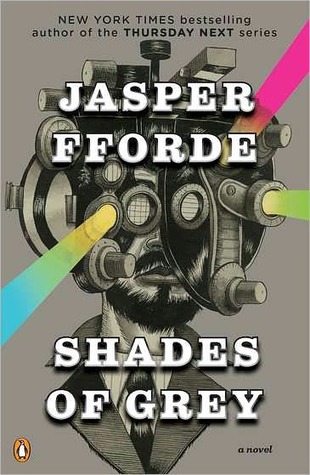 a Post-Apocalyptic Comedy of Manners set within a Provincial Dystopic Colortocracy! how's that for original?
best of all, for me at least, this wonderful novel does not have a genuinely cynical bone in its body. yes, it skewers hypocrisy and stupidity in the most cutting way. yes, it is about a vicious, cruel future. but it also believes in investing its hero and heroine with the power to change themselves, to fall in love, to try to bravely risk changing the world around them. and it portrays all of the good and all of the bad with the lightest, most charming of touches.
i am really looking forward to the sequel!
the world of Shades of Grey is a nightmarish dystopia: a ruthless totalitarian regime that destroys all individualistic spirit, all creativity and ambiguity and questioning of authority; a monstrous government that divides its citizens into color-stratified class/caste systems that is based upon the inherent physical deficiencies of its populace; a place with no love and where death is the end result for the underdog and misfit.sounds pretty bleak, right? well, dear reader, think again! this rather amazing novel is as light and airy as a souffle, a real pleasure to consume from beginning to end. i was smiling constantly and laughing out loud nearly as often. the tone is brisk and drily amusing. the plot and the various details of our young hero's travails are wonderfully absurd: the punishment for his past cheekiness is to conduct a "Chair Census"; he must beware deadly carnivorous swans and "mega-fauna"; his greatest ambition is to be the head of a String Factory! upstairs from him and his dad lives the "Apocryphal Man" - an historian the state has deemed 'does not exist', and so is free to wander around naked, stealing food, muttering terrifying truths yet remaining unmolested. the love of his life is mean Jane - a Grey, the lowest caste - a rebel with a cause who does not hesitate to punish him drastically whenever he gets in her way.the writing itself is splendid. Fforde is a deadpan and satirical author with a perfect grasp of what to show, what to tell, what to keep hidden, and what to save for an exciting climax. i was reminded of several things when reading this book: the equally absurd and distinctly provincial post-apocalyptic settings of Dick's Dr. Bloodmoney and Miller's A Canticle for Leibowitz, and especially the delightful skewerings of english village life within the Mapp & Lucia series of E.F. Benson. much like the latter, the humor within Shades of Grey is derived almost entirely from the Comedy of Manners. a Post-Apocalyptic Comedy of Manners set within a Provincial Dystopic Colortocracy! how's that for original?best of all, for me at least, this wonderful novel does not have a genuinely cynical bone in its body. yes, it skewers hypocrisy and stupidity in the most cutting way. yes, it is about a vicious, cruel future. but it also believes in investing its hero and heroine with the power to change themselves, to fall in love, to try to bravely risk changing the world around them. and it portrays all of the good and all of the bad with the lightest, most charming of touches.
i am really looking forward to the sequel!
Saturday, August 31, 2013
Chronicles of the Black Company
by Glen Cook
war is hell. hell is other people. other people are other people. other people have their problems. i have my own problems. my people are my people. their goals are my goals. we do what we can. we fight in a war. war is a business. war is our business.
The Black Company is a mercenary outfit. they are from the South; they currently work in the North. they fight for the Lady. they fight against the Rebel. they fight against the Lady. they fight for the White Rose. they fight for the Lady again. they fight for evil, they fight for good. they fight for who pays them. they fight against those who are against them. they do terrible things. they do some good things too.
 Glen Cook was in the military. he understands what could be called the military mindset, i suppose. his characters feel completely real. they feel like real soldiers. they are cynical; they follow orders; their first loyalty is to each other. Cook writes in choppy, abrupt, stripped down prose, like a journalist writing on-the-spot field reports. his prose is not rich or lyrical, it does not glow, it does not leap off of the page. his characters have names like "Croaker" and "Darling" and "Shed" and "One-Eye". his cities have names like "Rust" and "Oar" and "Opal" and "Roses". there is a crude poetry to his prose. it is perfectly suited to what this series is trying to accomplish.
i read some reviews of this series before writing this review. a regular complaint is the lack of beauty in Cook's naming of people and places; a certain lack of fantastickal whimsy or majesty in the writing itself. SWOOSH, you are missing the point. The Black Company series is indeed pure fantasy - it contains magic and monsters and wizards and epic battles involving magic, monsters, and wizards. and yet its goal appears to be to reduce all the lavish world-building and all of the lustrous magic within those fantasy elements in service of making something that actually feels real. something that feels dark and dirty, and yet because of that dark dirtiness, something that also feels alive and warm. Cook does not write with a flair for microscopic detail; he does not envision his characters as having larger-than-life personalities or operatically tragic narrative trajectories. he is not George RR Martin. nor does Cook write with snarky, sizzling wit or an eye for the cinematic action sequence or a need to surprise the reader with various malevolent sucker punches. he is not Joe Abercrombie. he writes from a ground-eye view, from a working man's perspective, through the eyes of people who are neither all good nor all bad, but who are just trying to do what they can with what they have been given. they want to get paid, they do not hunger for danger, they want to make their lives a little better. so when the realization dawns that these disreputable, shady, completely fallible characters are trying to accomplish some good with what little they have available... well, it is a beautiful thing. if shades of grey can be considered a beautiful thing.
and he doesn't just do this for his soldiers. the third book portrays a powerful god-tree as a being who is just trying to do a job that needs to be done. he's grumpy about it. he is not particularly sympathetic to other people's problems. he's a good guy, apparently - but a disinterested one. after all, he has to focus on his own work. the series also features a rather loathsome innkeeper and various malevolent sorcerers and tyrants. they get the same treatment... after all, who is a villain in their own mind? the eventual realization that a loathsome innkeeper and a terrible sorceress-tyrant are also trying to do what little good they can accomplish comes slowly and is mapped out carefully, hints dropped nonchalantly, an accumulation of evidence. Cook does not push this revelation on the reader... it just is what it is. and so characters like Shed the Innkeeper and the tyrant known as the Lady - much like soldiers with names like Elmo and Croaker and the Captain and the Lieutenant - become real in a way that i have seldom seen accomplished in other works of fantasy.
great job, Cook. no wonder your series is such a cult classic.
although i think the first novel in the series is clearly the strongest, the entire trilogy is certainly a worthy experience. if you are in the right mindset, if military fantasy doesn't bother your more progressive sentiments, if you actually don't need things like sentiment in your fantasy.
"Oh, 'twould be marvelous if the world and its moral questions were like some game board, with plain black players and white, and fixed rules, and nary a shade of grey."
war is hell. hell is other people. other people are other people. other people have their problems. i have my own problems. my people are my people. their goals are my goals. we do what we can. we fight in a war. war is a business. war is our business.
The Black Company is a mercenary outfit. they are from the South; they currently work in the North. they fight for the Lady. they fight against the Rebel. they fight against the Lady. they fight for the White Rose. they fight for the Lady again. they fight for evil, they fight for good. they fight for who pays them. they fight against those who are against them. they do terrible things. they do some good things too.
Glen Cook was in the military. he understands what could be called the military mindset, i suppose. his characters feel completely real. they feel like real soldiers. they are cynical; they follow orders; their first loyalty is to each other. Cook writes in choppy, abrupt, stripped down prose, like a journalist writing on-the-spot field reports. his prose is not rich or lyrical, it does not glow, it does not leap off of the page. his characters have names like "Croaker" and "Darling" and "Shed" and "One-Eye". his cities have names like "Rust" and "Oar" and "Opal" and "Roses". there is a crude poetry to his prose. it is perfectly suited to what this series is trying to accomplish.i read some reviews of this series before writing this review. a regular complaint is the lack of beauty in Cook's naming of people and places; a certain lack of fantastickal whimsy or majesty in the writing itself. SWOOSH, you are missing the point. The Black Company series is indeed pure fantasy - it contains magic and monsters and wizards and epic battles involving magic, monsters, and wizards. and yet its goal appears to be to reduce all the lavish world-building and all of the lustrous magic within those fantasy elements in service of making something that actually feels real. something that feels dark and dirty, and yet because of that dark dirtiness, something that also feels alive and warm. Cook does not write with a flair for microscopic detail; he does not envision his characters as having larger-than-life personalities or operatically tragic narrative trajectories. he is not George RR Martin. nor does Cook write with snarky, sizzling wit or an eye for the cinematic action sequence or a need to surprise the reader with various malevolent sucker punches. he is not Joe Abercrombie. he writes from a ground-eye view, from a working man's perspective, through the eyes of people who are neither all good nor all bad, but who are just trying to do what they can with what they have been given. they want to get paid, they do not hunger for danger, they want to make their lives a little better. so when the realization dawns that these disreputable, shady, completely fallible characters are trying to accomplish some good with what little they have available... well, it is a beautiful thing. if shades of grey can be considered a beautiful thing.
and he doesn't just do this for his soldiers. the third book portrays a powerful god-tree as a being who is just trying to do a job that needs to be done. he's grumpy about it. he is not particularly sympathetic to other people's problems. he's a good guy, apparently - but a disinterested one. after all, he has to focus on his own work. the series also features a rather loathsome innkeeper and various malevolent sorcerers and tyrants. they get the same treatment... after all, who is a villain in their own mind? the eventual realization that a loathsome innkeeper and a terrible sorceress-tyrant are also trying to do what little good they can accomplish comes slowly and is mapped out carefully, hints dropped nonchalantly, an accumulation of evidence. Cook does not push this revelation on the reader... it just is what it is. and so characters like Shed the Innkeeper and the tyrant known as the Lady - much like soldiers with names like Elmo and Croaker and the Captain and the Lieutenant - become real in a way that i have seldom seen accomplished in other works of fantasy.
great job, Cook. no wonder your series is such a cult classic.
although i think the first novel in the series is clearly the strongest, the entire trilogy is certainly a worthy experience. if you are in the right mindset, if military fantasy doesn't bother your more progressive sentiments, if you actually don't need things like sentiment in your fantasy.
Saturday, August 24, 2013
Star of Danger
by Marion Zimmer Bradley
 an entry in the Darkover cycle. pleasantly enjoyable overall, but also slim and rather forgettable. this one concerns Larry Montray, Terran, and his teen adventures on the wintry, semi-barbaric world of Darkover. those adventures come complete with assorted monsters & aliens, bullying street urchins & dastardly kidnapping bandits, psychic powers, a forest fire, an amusingly antagonistic bromance between our hero & an arrogant Darkovan lordling, and much contemplation & conversating regarding the nature of being a man & what constitutes honor in a fight (i prefer the Darkover belief system that loathes guns & bombs as the weak man's choice). this early novel in the long-running series has none of the mid-saga's books' fervent, near-hysterical emotional content nor their sometimes moving, other times soap operatic deconstruction of gender & sexual orientation. it is a pleasingly straightforward, clearly written, earnest young adult novel filled with boyish enthusiasm, teenage angst, and on-the-cusp-of-maturity musings on Adulthood. probably a good starting point for kids interested in Darkover. but are there any even out there?
Wednesday, August 21, 2013
The Last Unicorn
by Peter S. Beagle
 so i set the mood for rereading The Last Unicorn by putting together a nifty mix of woodstock era classics, heavily featuring the likes of jethro tull & canned heat & richie havens & a lot of early pink floyd. i put on my comfy clothes. i brewed some tea. i picked my sunniest room and my cat - sensing my mood - snuggled in close. however, i did not smoke any weed. perhaps this was my mistake? nonetheless, the mood was definitely set and the enjoyment swiftly commenced.
this is a nice little book. it's sweet and cheeky and full of a kind of idealistic purity. it is very counter-culture in its quiet way. i was reminded constantly of things like Harold & Maude and King of Hearts and the Yellow Submarine and Jonathan Livingston Seagull. and of laying out on the grass with my friends during college in the 90s, happily on drugs and talking about life. it made me think of flowers and sunshine and animals that i like. this is certainly not a trippy book, but it is a pleasantly mellow one in tone and outlook. the writing is similarly warm and fuzzy. characterization is relaxed; living metaphors for freedom & authority & purity & greed & experience are mixed and matched in a loose, breathable fashion. the entire endeavor is what one would call a warm and human experience. i can see why this book has so many admirers and why it has apparently never been out of print. reading it is like reading a modern fable - it feels instantly classic, automatically timeless. and hopefully its beautiful messages about life and how to live it will never go out of style.
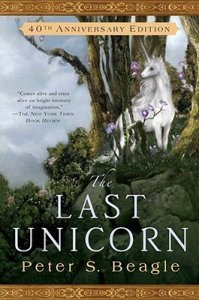 my favorite parts came early and then at the very end. the final standoff between our heroes and the Red Bull was very well done and genuinely gripping. even better was the time spent in Mommy Fortuna's horrible caravan. that was awesome! the descriptions of the different ensorcelled beasts, the dreaming spider, Schmendrick's introduction, Mommy Fortuna herself (such a poisonous yet rather sad & pathetic character), Mommy Fortuna as Old Age, and of course the terrifying, brilliantly rendered harpy... all quite delectable.
it's interesting to me to think about my two different reactions to the book: now and then. "then" was back in junior high, i think. i LOVED Schmendrick and found Molly Grue to be an annoying, tedious character. despite her, i loved the book from beginning to end. the beauty of its ultimate meaning (whatever that may have been to my 14-year old self) had me thinking about life and how to live it. many, many years later - yesterday! - i found Schmendrick to be distinctly annoying and Molly Grue to be the secret hero of the novel. this grouchy, critical, often overbearing middle-aged lady is also brave, honest, decent, completely down to earth - and such an unusual character to find as a lead in a fantasy novel. go, Molly, go! unfortunately, i also found myself to be positively un-charmed by all the anachronisms and whimsy. all that stuff just felt dated, goofy, sorta cheap. like that fookin butterfly for chrissakes. so unfunny. and judo. and "last of the red-hot swamis". and much more. ugh!
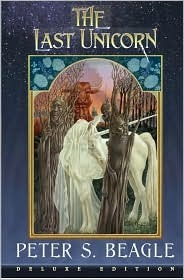
still, a lovely book with a timeless message. although i found those whimsical anachronisms to be obnoxiously precious & cutesy-poo, overall they didn't end up being too dire and my experience was not remotely ruined. hell, i roll my eyes at my closest friends and i still enjoy their company. so i did like The Last Unicorn quite a bit. it is sweetly appealing and genuinely charming.
so i set the mood for rereading The Last Unicorn by putting together a nifty mix of woodstock era classics, heavily featuring the likes of jethro tull & canned heat & richie havens & a lot of early pink floyd. i put on my comfy clothes. i brewed some tea. i picked my sunniest room and my cat - sensing my mood - snuggled in close. however, i did not smoke any weed. perhaps this was my mistake? nonetheless, the mood was definitely set and the enjoyment swiftly commenced.this is a nice little book. it's sweet and cheeky and full of a kind of idealistic purity. it is very counter-culture in its quiet way. i was reminded constantly of things like Harold & Maude and King of Hearts and the Yellow Submarine and Jonathan Livingston Seagull. and of laying out on the grass with my friends during college in the 90s, happily on drugs and talking about life. it made me think of flowers and sunshine and animals that i like. this is certainly not a trippy book, but it is a pleasantly mellow one in tone and outlook. the writing is similarly warm and fuzzy. characterization is relaxed; living metaphors for freedom & authority & purity & greed & experience are mixed and matched in a loose, breathable fashion. the entire endeavor is what one would call a warm and human experience. i can see why this book has so many admirers and why it has apparently never been out of print. reading it is like reading a modern fable - it feels instantly classic, automatically timeless. and hopefully its beautiful messages about life and how to live it will never go out of style.
my favorite parts came early and then at the very end. the final standoff between our heroes and the Red Bull was very well done and genuinely gripping. even better was the time spent in Mommy Fortuna's horrible caravan. that was awesome! the descriptions of the different ensorcelled beasts, the dreaming spider, Schmendrick's introduction, Mommy Fortuna herself (such a poisonous yet rather sad & pathetic character), Mommy Fortuna as Old Age, and of course the terrifying, brilliantly rendered harpy... all quite delectable.it's interesting to me to think about my two different reactions to the book: now and then. "then" was back in junior high, i think. i LOVED Schmendrick and found Molly Grue to be an annoying, tedious character. despite her, i loved the book from beginning to end. the beauty of its ultimate meaning (whatever that may have been to my 14-year old self) had me thinking about life and how to live it. many, many years later - yesterday! - i found Schmendrick to be distinctly annoying and Molly Grue to be the secret hero of the novel. this grouchy, critical, often overbearing middle-aged lady is also brave, honest, decent, completely down to earth - and such an unusual character to find as a lead in a fantasy novel. go, Molly, go! unfortunately, i also found myself to be positively un-charmed by all the anachronisms and whimsy. all that stuff just felt dated, goofy, sorta cheap. like that fookin butterfly for chrissakes. so unfunny. and judo. and "last of the red-hot swamis". and much more. ugh!
still, a lovely book with a timeless message. although i found those whimsical anachronisms to be obnoxiously precious & cutesy-poo, overall they didn't end up being too dire and my experience was not remotely ruined. hell, i roll my eyes at my closest friends and i still enjoy their company. so i did like The Last Unicorn quite a bit. it is sweetly appealing and genuinely charming.
Wednesday, August 7, 2013
Dr. Bloodmoney
by Philip K. Dick
 Dick places his absurdist situations, bleak scenarios, and quirky characters within an almost pastoral post-apocalyptic san francisco-bay area. the setting is primarily a small town in marin, with everyday people slowly trying to rebuild themselves and their world. the writing is typically loose and off-kilter. results are sublime. and very strange, per usual. two oddly endearing yet threatening characters stood out for me amongst the compellingly diverse cast: Hoppy Harrington - cringing, deluded, armless & legless, gifted with increasingly terrifying powers and a very specific plan to take over the world; his nemesis Bill - whiny, yearning, able to speak to the dead, an unborn twin to a self-absorbed 7-year old girl, longing for a release into the larger world. watching these two face off against each other was worth the price of admission - their escalating conflicts are wonderfully amusing and often genuinely thrilling. and yet they are but two pieces in an intriguingly mystifying and often ironic larger puzzle.
this is a book of many minor, human notes; mournful and hopeful in equal measures. a true pleasure to read.
Dick places his absurdist situations, bleak scenarios, and quirky characters within an almost pastoral post-apocalyptic san francisco-bay area. the setting is primarily a small town in marin, with everyday people slowly trying to rebuild themselves and their world. the writing is typically loose and off-kilter. results are sublime. and very strange, per usual. two oddly endearing yet threatening characters stood out for me amongst the compellingly diverse cast: Hoppy Harrington - cringing, deluded, armless & legless, gifted with increasingly terrifying powers and a very specific plan to take over the world; his nemesis Bill - whiny, yearning, able to speak to the dead, an unborn twin to a self-absorbed 7-year old girl, longing for a release into the larger world. watching these two face off against each other was worth the price of admission - their escalating conflicts are wonderfully amusing and often genuinely thrilling. and yet they are but two pieces in an intriguingly mystifying and often ironic larger puzzle.this is a book of many minor, human notes; mournful and hopeful in equal measures. a true pleasure to read.
Subscribe to:
Posts (Atom)